
Have you ever watched a show in Spanish or French and suddenly thought, “Wait, what did they just say?” It wasn’t the vocabulary or grammar that confused you—it was the accent. That’s totally normal! In fact, many advanced learners struggle when they try to understand different accents in a language. But here’s the good news: Netflix might be your new secret weapon.
Netflix’s massive global library is full of content from around the world. And with the right tools, like dual subtitles and smart translation support, you can train your ear to understand different accents in a language with ease. From Spanish in Spain to Spanish in Mexico, or French in Paris to French in Quebec, you’ll quickly notice how accents shape meaning, rhythm, and slang.
Let’s explore how you can make Netflix your dialect decoder and finally feel confident when you hear any variation of your target language.
Why Understanding Accents Is the Next Step in Fluency
So, you’ve mastered vocabulary and grammar? Great. But then you watch a Quebecois drama and it feels like a completely different language. That’s because accents can drastically change how words sound.
Understanding different accents in a language means you’re stepping into real fluency territory. Textbooks won’t teach you how “je” turns into “chu” in Quebec French, or how “usted” gets dropped in casual Mexican Spanish. These subtle changes represent regional identity, social tone, and often local slang.
If you truly want to sound natural and understand native speakers in real life—not just in classrooms—then learning to understand different accents in a language is the key.
How Netflix’s Global Library Exposes You to Real Regional Accents
Netflix is a global giant, which means it’s your gateway to a universe of accents. You can hop from one region to another with a click.
Real examples to explore:
- Spain: La Casa de Papel – Castilian Spanish at its finest.
- Mexico: Who Killed Sara? – Faster, more relaxed, with different slang.
- Argentina: El Reino – Strong Rioplatense accent.
- Québec: M’entends-tu? – French with a whole different melody.
- France: Lupin – Elegant Parisian French.
Each of these shows helps you understand different accents in a language by giving real-life exposure, not artificial textbook tones.
Practical Tips to Train Your Ear with Netflix
Ready to tune your ears like a native speaker? Here’s how you can do it effectively:
- Alternate shows from different regions: One episode from Spain, one from Mexico.
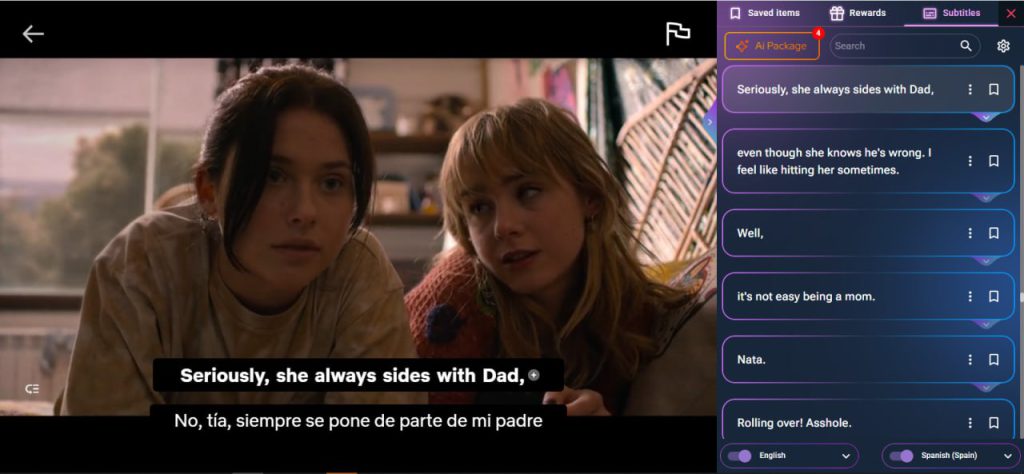
- Turn on dual subtitles: Compare your language and the target one.
- Use Smart Pause & Auto-Rewind: Replay tricky phrases effortlessly.
- Shadow native actors: Repeat what they say, match their intonation.
- Use hover-over translations: Get instant meanings of confusing regional slang.
All of this makes it easier to understand different accents in a language without stress.
Features That Make This Extension a Dialect Decoder
With our “Learning Language with Netflix” extension, you’re not just watching—you’re learning deeply.
Key features:
- Smart Pause lets you replay a scene until it clicks.
- Instant translations help you decode local slang instantly.
- Grammar & pronunciation hints powered by AI.
- Flashcards for accent-specific vocab.
- Word Roadmap™ tracks how well you’re absorbing regional speech.
- Subtitle toggling: Watch the same show in different subtitle variants if available.
These features help you truly understand different accents in a language over time.
Regional Slang: Examples from Spanish, French, and English Shows
Here’s a quick cheat sheet to get you started:
| Language | Term | Region | Meaning | Example Show |
|---|---|---|---|---|
| Spanish | “vale” | Spain | okay | La Casa de Papel |
| Spanish | “órale” | Mexico | wow/come on | Who Killed Sara? |
| French | “char” | Quebec | car | M’entends-tu? |
| English | “cheers” | UK | thanks | The Crown |
Learning these terms in context will help you understand different accents in a language much faster.
Why Accents Are Hard — and Why You Shouldn’t Avoid Them
Let’s be honest: different accents can be frustrating. You might wonder, “Should I just stick to one standard version?” But don’t!
If your goal is fluency, avoiding accents will only hold you back. Different accents in a language reflect culture, humor, emotion, and social norms. They give you the full picture.
The more accents you can understand, the more confident and flexible you’ll become. Plus, it’s fun to decode them—it’s like solving a language puzzle!
Start Training Your Ear Today — Step-by-Step Guide
Here’s how to get started now:
- Install our Chrome extension.
- Pick a show from a specific region.
- Enable dual subtitles.
- Turn on Smart Pause.
- Hover over unfamiliar slang.
- Save expressions to review later.
- Use Flashcards and Fluency Gym to reinforce.
Follow this plan regularly and you’ll soon understand different accents in a language like a pro.
Conclusion
Understanding different accents in a language isn’t just for advanced learners—it’s for anyone who wants to truly connect with real people. With Netflix’s global library and the Learning Language with Netflix extension, you’re set up for success.
👉 Don’t just memorize words. Hear them. Feel them. Live them.
Want to take your listening even further? Check out @SpeakingAndListeningGYM on YouTube. It’s filled with bite-sized listening challenges to boost your real-world comprehension.