
Watching films can be more than entertainment: it can become a structured method to learn a language by watching movies. This guide is for B2 learners who want clear routines for grammar rules, vocabulary acquisition, and understanding formal vs. informal usage—using language learning with movies and TV shows in a smart, repeatable way.and how to learn English with movies B2.
The “Dual Subtitle” Strategy: Learn Faster Without Getting Stuck
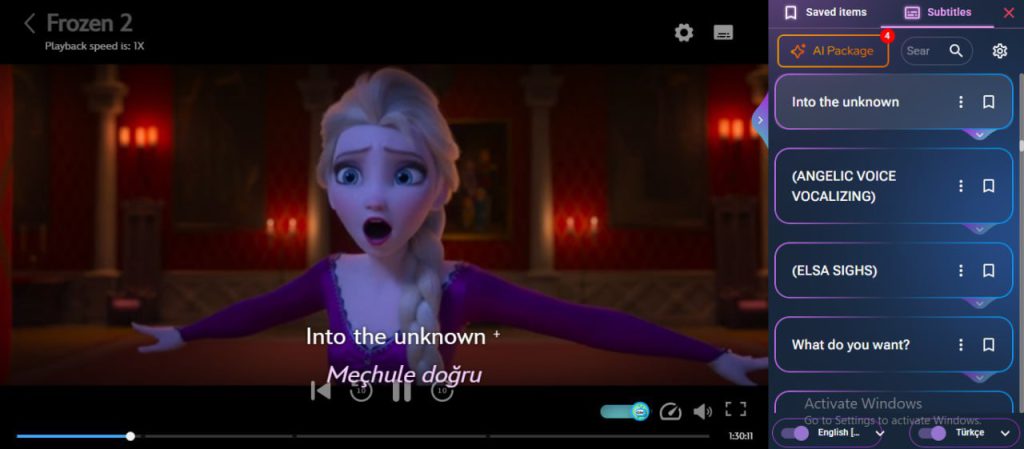
Your goal isn’t to understand 100% on the first watch. Your goal is to build comprehension and then convert scenes into repeatable language practice. A practical dual-subtitle routine:
-
First watch: English audio + English subtitles (focus on connecting sound to spelling).
-
Second watch (same episode/scene): English audio + no subtitles (train listening and prediction).
-
Third pass (optional): replay only key moments with subtitles to confirm details and collect new language.
If your subtitles are always on, listening stays passive. If subtitles are always off, you miss useful detail. Rotate modes deliberately.
Set Up Your Movie-Based Language Learning Toolkit (5 Minutes)
-
A streaming platform that allows subtitle control (ideally speed control too).
-
A notes app (or Anki/flashcards) for vocabulary.
-
A simple “scene log”: title, timestamp, new words, grammar patterns, best line to imitate.
-
Optional: a transcript source (some shows have scripts online).
This setup supports English subtitles for language learning while keeping your practice organized and measurable.
12 Movie-Based Language Learning Tips (B2 Level)
1) Choose the right difficulty (B2 rule of thumb)
Pick content where you understand roughly 70–85% with English subtitles. If you need to pause every sentence, it’s too hard. If everything is easy, your growth slows. This is the foundation of strong B2 English listening practice with films.
2) Work in “scenes,” not whole movies
Select 2–4 minute scenes with lots of dialogue (negotiations, arguments, interviews). Rewatching short scenes creates repetition—the secret ingredient in how to learn English with movies B2.
3) Turn dialogue into vocabulary systems (not random word lists)
To improve English vocabulary through movies, collect language in chunks: collocations, phrasal verbs, and fixed phrases. Example categories: agreement (“That makes sense”), polite refusal (“I’m afraid I can’t”), emphasis (“What I’m trying to say is…”).
4) Track register: formal vs. informal usage
Movies are excellent for register. Make two columns in your notes: Formal vs. Informal. Example:
-
Formal: “I appreciate your help.” / Informal: “Thanks, I owe you.”
-
Formal: “Could you clarify?” / Informal: “What do you mean?”
-
Formal: “I regret to inform you…” / Informal: “Bad news…”
5) Use “micro-grammar hunting” while you watch
Choose one grammar target per session and spot it repeatedly in real context. Great B2 targets:
-
Modal verbs for deduction: “She must be lying,” “He might be serious.”
-
Conditionals: “If you’d told me, I would’ve helped.”
-
Reported speech: “He said he’d call.”
-
Discourse markers: “Actually,” “To be honest,” “In other words…”
6) Pause only for “high-value” lines
Don’t pause for every unknown word. Pause when the line is (a) repeated, (b) emotionally strong, (c) useful in real life, or (d) contains your grammar target. This keeps language learning with movies and TV shows enjoyable and efficient.
7) Try the shadowing technique with movie dialogue
The shadowing technique with movie dialogue builds listening, rhythm, and speaking automatically. Method: listen to one sentence → replay → speak with the actor → replay → speak after the actor. Aim for 10 lines per session.
8) Learn pronunciation from movies (focus on connected speech)
To learn pronunciation from movies, focus less on single sounds and more on connected speech: linking, reduction, and stress. Note what disappears: “going to” → “gonna,” “want to” → “wanna” (informal). Mark stress with caps: “I DIDN’T say that.”
9) Use subtitles as a tool—not a crutch
For English subtitles for language learning, try this pattern for one scene:
-
Watch with subtitles and underline 3 useful lines.
-
Watch again without subtitles and try to “hear” those same lines.
-
Watch a third time to confirm accuracy and fix mistakes.
10) Do “movie dictation” once a week
Pick 20–40 seconds of dialogue and write what you hear (no subtitles). Then check with subtitles. This reveals exactly what your ears miss—perfect for B2 English listening practice with films.
11) Turn scenes into speaking prompts (B2 upgrade)
After a scene, summarize it in 5–7 sentences using at least (a) two discourse markers, (b) one modal of deduction, and (c) one conditional. This turns passive watching into active production—key in how to learn English with movies.
12) Review like a language learner, not a fan
Repetition is where progress happens. Rewatch your “training scenes” across the week. You’ll notice new grammar and clearer pronunciation each time, and your vocabulary becomes automatic—exactly how to learn a language by watching movies long-term.
Best Movies to Learn English (B2-Friendly Picks)
These choices balance clear speech, useful everyday language, and enough complexity for B2. Use them as best movies to learn English B2 options—then apply the tips above.
-
The King’s Speech — excellent for articulation, public speaking, and formal register.
-
items is not null but must be array of strings.