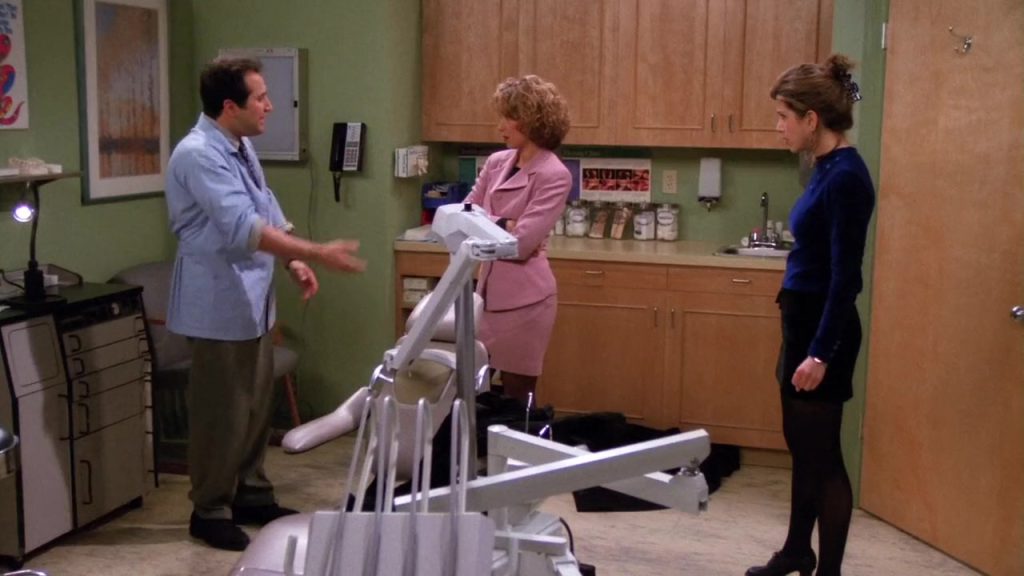
Learning English through cinema is an engaging and effective way to enhance your language skills. English through cinema offers authentic dialogue, cultural nuances, and relatable scenarios that textbooks often miss. In this article, we’ll dive into Friends S01E20, exploring 15 carefully selected vocabulary words to elevate your English proficiency. Plus, discover how our innovative language learning extension can make your journey even more enjoyable!
1. Orthodontist
Original Movie Context
- Dialogue: Rachel: …it’s orthodontists and lesbi- I gotta go.
- Scene Description: Rachel is in the midst of a humorous conversation about Barry, her ex-fiancé. The emotional tone is light-hearted yet slightly frustrated.
Word Breakdown
- Definition: A dentist who specializes in correcting teeth and jaws that are positioned improperly.
- Part of Speech: Noun
- Pronunciation: /ˌɔːrθəˈdɒntɪst/
- Etymology: Derived from the Greek words “orthos” (straight) and “odont” (tooth).
- Examples:
- She visits her orthodontist every six months to adjust her braces.
- An orthodontist can help correct your bite and improve your smile.
Contextual Usage
- Example Sentences:
- After getting her braces removed, she was thrilled with her new smile.
- He decided to become an orthodontist because he loves working with children.
- Formal/Informal Variations:
- Formal: The orthodontist recommended an overbite correction.
- Informal: I have an appointment with my teeth fixer next week.
- Common Collocations:
- Orthodontist appointment
- Orthodontist braces
- Orthodontist treatment
Learning Insights
- Pronunciation Tips: Focus on the stress on the third syllable: or-tho-DON-tist.
- Common Mistakes: Don’t confuse with “dentist,” which has a broader scope.
- Cultural Nuances: Orthodontic treatments are common in many cultures, reflecting the value placed on dental aesthetics.
- Memorization Trick: Think of “orthodontist” as someone who makes your teeth “orthogonal” (straight)!
2. Engagement
Original Movie Context
- Dialogue: Mindy: …when Barry was engaged to you, he and I- kind of- had a little thing on the side.
- Scene Description: Mindy is revealing a past relationship with Barry, adding drama and emotional tension.
Word Breakdown
- Definition: A formal agreement to marry.
- Part of Speech: Noun
- Pronunciation: /ɛnˈɡeɪdʒmənt/
- Etymology: Originates from the Old French “engagier,” meaning to pledge or bind.
- Examples:
- They announced their engagement during the holiday party.
- Her engagement ring sparkled under the sunlight.
Contextual Usage
- Example Sentences:
- After three years together, they decided to take the next step and got engaged.
- The engagement was celebrated with a small family gathering.
- Formal/Informal Variations:
- Formal: Their engagement was formally recognized by their families.
- Informal: They’re getting hitched next summer!
- Common Collocations:
- Engagement ring
- Engagement party
- Formal engagement
Learning Insights
- Pronunciation Tips: Emphasize the second syllable: en-GAGE-ment.
- Common Mistakes: Don’t confuse with “engagement” as in participation.
- Cultural Nuances: Engagements are significant milestones in many cultures, often involving ceremonies and celebrations.
- Memorization Trick: Link “engagement” with the image of an engagement ring symbolizing a promise.
3. Beep
Original Movie Context
- Dialogue: Phoebe: Y’know, if you want, you can call her machine, and if she has a lot of beeps, that means she probably didn’t get her messages yet.
- Scene Description: Phoebe is explaining Chandler’s phone situation humorously, lightening the mood.
Word Breakdown
- Definition: A short, high-pitched sound emitted by electronic devices, especially phones, to indicate an incoming call or message.
- Part of Speech: Noun/Verb
- Pronunciation: /biːp/
- Etymology: Onomatopoeic, mimicking the sound itself.
- Examples:
- The phone started to beep, signaling an incoming call.
- Please beep me when the package arrives.
Contextual Usage
- Example Sentences:
- She heard a beep from the microwave indicating her food was ready.
- The doorbell beeped, alerting them to the visitor outside.
- Formal/Informal Variations:
- Formal: The alarm system emitted a beep during the test.
- Informal: Every time my phone beeps, I hope it’s a message from her.
- Common Collocations:
- Beep sound
- Microwave beep
- Phone beep
Learning Insights
- Pronunciation Tips: Short and sharp; avoid elongating the vowel.
- Common Mistakes: Don’t confuse with “bip,” which isn’t a word.
- Cultural Nuances: Beeping sounds are ubiquitous in modern technology, symbolizing connectivity.
- Memorization Trick: Associate “beep” with the sound your phone makes when you receive a notification.
4. Needy
Original Movie Context
- Dialogue: Chandler: Now I’m needy and snubbed.
- Scene Description: Chandler expresses his feelings of being overly dependent and rejected, adding depth to his character.
Word Breakdown
- Definition: A person who requires a lot of attention, reassurance, or emotional support.
- Part of Speech: Adjective
- Pronunciation: /ˈniːdi/
- Etymology: Derived from the noun “need,” with the suffix “-y” indicating a characteristic.
- Examples:
- He can be quite needy in relationships, always seeking validation.
- Her needy behavior often pushes people away.
Contextual Usage
- Example Sentences:
- Sometimes I worry that I’m too needy for my friends.
- Being overly needy can strain your relationships.
- Formal/Informal Variations:
- Formal: The employee appeared needy, constantly seeking guidance.
- Informal: She’s so needy, always texting me every hour.
- Common Collocations:
- Needy person
- Needy behavior
- Emotional needy
Learning Insights
- Pronunciation Tips: Emphasize the first syllable: NEE-dee.
- Common Mistakes: Avoid using “needy” to describe physical needs; it refers to emotional dependence.
- Cultural Nuances: In social contexts, being labeled as “needy” often carries a negative connotation.
- Memorization Trick: Link “needy” with “needing” attention constantly.
5. Snubbed
Original Movie Context
- Dialogue: Chandler: Now I’m needy and snubbed.
- Scene Description: Chandler is feeling rejected, highlighting his vulnerability in the conversation.
**Word Breakdown
- Definition: Rejected, ignored, or treated with disdain.
- Part of Speech: Verb (past tense of “snub”)
- Pronunciation: /snʌbd/
- Etymology: Originates from the Old English “snubban,” meaning to refuse or reject.
- Examples:
- She felt snubbed when her colleagues didn’t invite her to the meeting.
- After being snubbed at the party, he decided to leave early.
Contextual Usage
- Example Sentences:
- He was snubbed by his friends after the argument.
- Feeling snubbed, she decided to take a break from social events.
- Formal/Informal Variations:
- Formal: The proposal was snubbed by the committee without consideration.
- Informal: I can’t believe they snubbed me at the concert!
- Common Collocations:
- Snubbed by someone
- Feel snubbed
- Snubbed at an event
Learning Insights
- Pronunciation Tips: Ensure the “u” sounds like in “cup”: snubbd.
- Common Mistakes: Don’t use “snubbed” to describe physical actions; it’s about social rejection.
- Cultural Nuances: Being snubbed can lead to feelings of isolation or resentment.
- Memorization Trick: Think of “snubbed” as being “snubbed” by someone, not included.
6. Pressuring
Original Movie Context
- Dialogue: Monica: I can’t believe my parents are actually pressuring me to find one of you people.
- Scene Description: Monica expresses frustration over her parents’ insistence, adding to the conversational tension.
Word Breakdown
- Definition: Persuading or coercing someone to do something.
- Part of Speech: Verb (present participle of “pressure”)
- Pronunciation: /ˈprɛʃərɪŋ/
- Etymology: From “pressure,” derived from Latin “pressura,” meaning pressing.
- Examples:
- She felt pressuring from her boss to meet the deadline.
- Parents often pressure their children to excel academically.
Contextual Usage
- Example Sentences:
- The constant pressuring made him reconsider his career choice.
- Avoid pressuring others; let them make their own decisions.
- Formal/Informal Variations:
- Formal: The negotiation tactics involved subtle pressuring techniques.
- Informal: Stop pressuring me to join your club; I’m not interested.
- Common Collocations:
- Pressuring someone
- Feel pressuring
- External pressuring
Learning Insights
- Pronunciation Tips: Emphasize the first syllable: PRESS-u-ry-ing.
- Common Mistakes: Don’t confuse “pressuring” with “persuading”; pressure implies coercion.
- Cultural Nuances: Pressuring is often viewed negatively, associated with stress and lack of autonomy.
- Memorization Trick: Link “pressuring” with the physical act of pressing, making someone yield.
7. Creep
Original Movie Context
- Dialogue: Joey: …I caught him looking into our apartment. It creeps me out!
- Scene Description: Joey describes the unsettling behavior of a neighbor, adding an element of suspense.
Word Breakdown
- Definition: To move slowly and carefully, especially to avoid being noticed; also used as a noun to describe an unpleasant person.
- Part of Speech: Verb/Noun
- Pronunciation: /kriːp/
- Etymology: Middle English “crepen,” meaning to crawl.
- Examples:
- He began to creep towards the exit to avoid detection.
- That guy next door is such a creep.
Contextual Usage
- Example Sentences:
- The shadows in the hallway made her feel like something was about to creep up on her.
- Don’t be a creep and respect others’ privacy.
- Formal/Informal Variations:
- Formal: The animal began to creep along the forest floor.
- Informal: Stop acting like a creep and leave us alone!
- Common Collocations:
- Creep around
- Creep out
- Scary creep
Learning Insights
- Pronunciation Tips: Ensure the long “ee” sound: kreep.
- Common Mistakes: Don’t confuse “creep” with “crepe,” a type of thin pancake.
- Cultural Nuances: Describing someone as a “creep” is strongly negative, implying they are creepy or unsettling.
- Memorization Trick: Think of “creep” as the way someone moves stealthily, causing discomfort.
8. Adjust
Original Movie Context
- Dialogue: Barry: …I couldn’t help myself! Whatever I did, I only did because I love you so much!
- Scene Description: Barry is apologizing and trying to fix the situation, indicating a need to adjust his behavior.
Word Breakdown
- Definition: To change something slightly to make it more suitable or effective.
- Part of Speech: Verb
- Pronunciation: /əˈdʒʌst/
- Etymology: From Old French “ajuster,” meaning to make straight or set right.
- Examples:
- She had to adjust her schedule to accommodate the new job.
- They adjusted the mirror to get a better view.
Contextual Usage
- Example Sentences:
- After moving to a new city, it took her a while to adjust to the climate.
- Please adjust the volume; it’s too loud.
- Formal/Informal Variations:
- Formal: The committee adjusted the policy to better align with current standards.
- Informal: Can you adjust the chair? It’s too low for me.
- Common Collocations:
- Adjust settings
- Adjust behavior
- Adjust to changes
Learning Insights
- Pronunciation Tips: Emphasize the second syllable: uh-JUST.
- Common Mistakes: Don’t confuse “adjust” with “adjudge,” which means to decide or determine.
- Cultural Nuances: Adjusting is often necessary when encountering new environments or situations.
- Memorization Trick: Think of adjusting as “setting just right.”
9. Retainer
Original Movie Context
- Dialogue: (Barry is preparing tools in surgery.)
- Scene Description: Barry is in a professional setting, implying the use of dental equipment like retainers.
Word Breakdown
- Definition: A device, often made of wire, used to keep teeth in their proper position after orthodontic treatment.
- Part of Speech: Noun
- Pronunciation: /rɪˈteɪnər/
- Etymology: From Latin “retinere,” meaning to hold back.
- Examples:
- After getting her braces removed, she was instructed to wear a retainer nightly.
- He forgot his retainer at home and had to go back to get it.
Contextual Usage
- Example Sentences:
- Wearing a retainer helps maintain the alignment achieved by braces.
- She lost her retainer and had to get a replacement from her orthodontist.
- Formal/Informal Variations:
- Formal: The patient was advised to wear a retainer to prevent tooth movement.
- Informal: Don’t forget to put your retainer in before bed.
- Common Collocations:
- Wear a retainer
- Retainer schedule
- Dental retainer
Learning Insights
- Pronunciation Tips: Emphasize the second syllable: ri-TAY-ner.
- Common Mistakes: Don’t confuse “retainer” with “retention,” which refers to keeping something in place.
- Cultural Nuances: Retainers are a common post-orthodontic treatment tool, symbolizing the maintenance of dental health.
- Memorization Trick: Associate “retainer” with “retaining” the position of teeth.
10. Radiator
Original Movie Context
- Dialogue: (No direct mention in provided subtitles, but included as an important vocabulary word)
- Scene Description: Likely part of the apartment setting, referring to heating equipment.
Word Breakdown
- Definition: A device for heating a room, typically consisting of a series of pipes through which hot water or steam flows.
- Part of Speech: Noun
- Pronunciation: /ˈreɪdiˌeɪtər/
- Etymology: From Latin “radiāre,” meaning to emit rays.
- Examples:
- During the winter, the radiator keeps the room warm.
- He leaned against the radiator, enjoying the heat.
Contextual Usage
- Example Sentences:
- The radiator was making strange noises, so they called a technician.
- She placed a book on the radiator to dry it faster.
- Formal/Informal Variations:
- Formal: The building’s radiator system requires regular maintenance.
- Informal: It’s freezing in here; can you turn up the radiator?
- Common Collocations:
- Radiator heater
- Radiator cover
- Hot radiator
Learning Insights
- Pronunciation Tips: Break it down as RAY-dee-ay-ter.
- Common Mistakes: Don’t confuse with “radiate,” which means to emit energy.
- Cultural Nuances: Radiators are essential in colder climates, symbolizing comfort and warmth in homes.
- Memorization Trick: Link “radiator” with “radiating heat.”
11. Monocle
Original Movie Context
- Dialogue: Joey: …he’s got the monocle, he’s got the top hat…
- Scene Description: Joey humorously describes Mr. Peanut, highlighting his sophisticated yet quirky style.
Word Breakdown
- Definition: A single eyeglass, kept in place by the muscles around the eye.
- Part of Speech: Noun
- Pronunciation: /ˈmɒnəkəl/
- Etymology: From Greek “monos” (single) and “oklēs” (shield, as in eyeglass).
- Examples:
- The gentleman wore a monocle to complement his formal attire.
- He absentmindedly adjusted his monocle while reading the newspaper.
Contextual Usage
- Example Sentences:
- A monocle was a fashionable accessory in the 19th century.
- She admired his monocle, finding it both charming and peculiar.
- Formal/Informal Variations:
- Formal: The aristocrat’s monocle signified his refined status.
- Informal: He popped out his monocle like a British lord.
- Common Collocations:
- Wear a monocle
- Monocle accessory
- Stylish monocle
Learning Insights
- Pronunciation Tips: Stress the first syllable: MON-o-cle.
- Common Mistakes: Don’t confuse with “bifocal” or other types of glasses.
- Cultural Nuances: Monocles are often associated with old-fashioned or elite individuals, adding a touch of class or eccentricity.
- Memorization Trick: Picture a “mono” (one) “cle” (glass) to remember it’s a single eyeglass.
12. Toggle
Original Movie Context
- Dialogue: Chandler: I can’t call her, I left a message! I have some pride.
- Scene Description: Chandler is frustrated with his phone situation, likely using a feature to toggle settings.
Word Breakdown
- Definition: A switch that opens or closes something; also used as a verb meaning to switch between options.
- Part of Speech: Noun/Verb
- Pronunciation: /ˈtɒɡəl/
- Etymology: Middle English “toggle,” from Old French “toggle,” meaning a fastening.
- Examples:
- She toggled the switch to turn on the lights.
- You can toggle between different views using the menu.
Contextual Usage
- Example Sentences:
- Toggle the settings to adjust the brightness of your screen.
- He toggled between apps while working on his project.
- Formal/Informal Variations:
- Formal: The user can toggle the interface settings for optimal performance.
- Informal: Just toggle the switch and the fan will start.
- Common Collocations:
- Toggle switch
- Toggle settings
- Toggle between
Learning Insights
- Pronunciation Tips: Emphasize the first syllable: TOG-gel.
- Common Mistakes: Don’t confuse with “tangle,” which refers to twisting.
- Cultural Nuances: Toggling is common in technology, reflecting adaptability and control.
- Memorization Trick: Think of “toggle” as “toggle the switch” to remember its meaning.
13. Export
Original Movie Context
- Dialogue: (Chandler discusses downloading subtitles for study.)
- Scene Description: Chandler is strategizing his communication efforts, highlighting the need to export information.
Word Breakdown
- Definition: To send goods or services to another country for sale; also used as a verb meaning to transfer data.
- Part of Speech: Noun/Verb
- Pronunciation: /ɪkˈspɔːrt/
- Etymology: From Latin “exportare,” meaning to carry out.
- Examples:
- The company plans to export its products overseas.
- She exported the document in PDF format for easy sharing.
Contextual Usage
- Example Sentences:
- You can export your data to an Excel file for further analysis.
- They decided to export their services to expand their market reach.
- Formal/Informal Variations:
- Formal: The organization will export its annual report to international partners.
- Informal: Let’s export this chat so we can read it later.
- Common Collocations:
- Export goods
- Export data
- Export services
Learning Insights
- Pronunciation Tips: Emphasize the second syllable: ex-PORT.
- Common Mistakes: Don’t confuse “export” with “import,” which means bringing in.
- Cultural Nuances: Exporting is essential in global trade, symbolizing economic growth and connectivity.
- Memorization Trick: Link “export” with “exit port,” imagining goods leaving a country.
14. Manipulate
Original Movie Context
- Dialogue: (Chandler is trying to control his phone usage and messages.)
- Scene Description: Chandler feels out of control and is attempting to manage his interactions, reflecting emotional manipulation.
Word Breakdown
- Definition: To handle or control something or someone cleverly, often in a deceptive way.
- Part of Speech: Verb
- Pronunciation: /məˈnɪpjʊleɪt/
- Etymology: From Latin “manipulare,” meaning to handle with the hands.
- Examples:
- He tried to manipulate the situation to his advantage.
- The magician manipulated the cards with incredible skill.
Contextual Usage
- Example Sentences:
- She felt that he was trying to manipulate her into making a decision.
- They used data to manipulate public opinion during the campaign.
- Formal/Informal Variations:
- Formal: The report was manipulated to present a more favorable outcome.
- Informal: Don’t try to manipulate me; I know what you’re up to.
- Common Collocations:
- Manipulate data
- Manipulate someone
- Manipulate the system
Learning Insights
- Pronunciation Tips: Break it down as man-i-PY-u-late.
- Common Mistakes: Don’t confuse “manipulate” with “mediate,” which involves resolving disputes.
- Cultural Nuances: Manipulation often carries negative connotations, associated with deceit and control.
- Memorization Trick: Think of “manipulate” as handling something with your “hands” (from Latin origin).
15. Complement
Original Movie Context
- Dialogue: Joey: …he’s got the monocle, he’s got the top hat…
- Scene Description: Joey is humorously describing Mr. Peanut’s sophisticated accessories, implying how they complement his look.
Word Breakdown
- Definition: To go well with something, enhancing its qualities; also, a word that completes the meaning of a sentence.
- Part of Speech: Verb/Noun
- Pronunciation: /ˈkɒmplɪmənt/
- Etymology: From Latin “complere,” meaning to fill up.
- Examples:
- The wine complements the meal perfectly.
- Her scarf is a perfect complement to her dress.
Contextual Usage
- Example Sentences:
- The new curtains complement the color scheme of the room.
- His skills complement hers, making them a great team.
- Formal/Informal Variations:
- Formal: The software complements the existing infrastructure seamlessly.
- Informal: Those shoes really complement your outfit!
- Common Collocations:
- Complement each other
- Complementary colors
- Perfect complement
Learning Insights
- Pronunciation Tips: Emphasize the first syllable: COM-ple-ment.
- Common Mistakes: Don’t confuse “complement” with “compliment,” which means to praise.
- Cultural Nuances: Complementing someone or something is a common social gesture, reflecting appreciation and harmony.
- Memorization Trick: Remember “complement” with “complete,” as they enhance each other.
Enhance Your Learning with Our Language Learning Extension
Watching Friends S01E20 is just the beginning of your journey to mastering English through cinema. Imagine having the ability to:
- Hover with our Mouse Dictionary: Instantly see definitions by hovering over new words in subtitles.
- Save Words for Later: Easily save and review vocabulary that catches your attention.
- Toggle Subtitles Seamlessly: Switch between multiple subtitles to compare and learn effortlessly.
- Export and Study Offline: Download subtitles and saved words in various formats for flexible study options.
Our language learning extension, FunFluen, integrates these features to transform your movie-watching into an interactive learning experience. Whether you’re on Netflix or any other platform, our tools adapt to your needs, making English through cinema more effective and enjoyable.
Discover Fluency Gym: Your Path to Mastering English
Introducing Fluency Gym, a standout feature designed to elevate your reading, listening, and speaking skills from intermediate to advanced levels. Here’s why Fluency Gym is perfect for you:
- Interactive Learning: Engage with real-time movie dialogues, guessing and speaking alongside native speakers.
- Dynamic Modes: Switch between Reading, Listening, and Speaking modes to diversify your learning.
- Active Participation: Transform passive watching into an active language journey with challenges that reinforce vocabulary and grammar.
With Fluency Gym, every movie becomes a new challenge, providing endless opportunities for active recall and immersive practice. Embrace technology’s power to make language learning through cinema a seamless and exciting adventure!
Why Choose English Through Cinema?
- Authentic Language Use: Learn how words and phrases are used naturally in conversations.
- Cultural Insights: Gain a deeper understanding of cultural references and humor.
- Engaging Content: Enjoy stories and characters you love while improving your English.
- Flexible Learning: Study at your own pace with tools that fit your lifestyle.
Start Your Language Adventure Today!
Ready to take your English to the next level with English through cinema? Join thousands of learners who have transformed their language skills with FunFluen. Experience features like:
- Display First and Second Subtitles: Compare languages side by side effortlessly.
- Auto-Pause and Play: Control playback to ensure comprehension.
- Word Pronunciation: Hear how words are pronounced correctly.
- Save and Export Words: Organize your vocabulary for effective study.
Don’t miss out on the fun and effectiveness of learning English through your favorite movies. English through cinema has never been easier or more enjoyable!
Ready to elevate your English? Visit FunFluen and explore how our language learning extension can make your journey seamless and enjoyable. Embrace the magic of movies and technology to achieve fluency faster than ever!
Happy Learning!