
Learning English with Netflix has become an exciting journey for many language learners around the world. And what better way to improve your vocabulary than by diving into one of the most iconic TV series of all time—Friends? In today’s article, we’ll explore some interesting words and phrases from Friends S03E04 that can elevate your English language skills. Along the way, we’ll uncover some fun ways to learn these words while watching your favorite shows, and show how our language learning extension can make this process even easier.
Vocabulary to Learn in This Article
In this article, you’ll be learning these valuable vocabulary words from Friends S03E04:
- Audition
- Guilt
- Flingin’-flangin’
- Missed my chance
- Hyena laugh
- Intrigued
- Tragedy
- Guilty pleasure
- Hang up
- Bunny-bump
Each of these words/phrases will help you understand not just the vocabulary but also how to use them in everyday conversations. So, let’s get started and have some fun with language learning!
1. Audition
Original Movie Context:
- “Joey: Maybe you can tell me. My agent would like to know why I didn’t show up at the audition I didn’t know I had today.”
- Scene Description: Joey is talking about missing an important acting audition, expressing his frustration in a humorous way.
Word Breakdown:
- Definition: A performance or trial that an actor does to demonstrate their skills to get a role or job.
- Part of Speech: Noun
- Pronunciation: /ɔːˈdɪʃən/
- Etymology: From Latin audītīō, meaning “a hearing.”
Contextual Usage:
- Example Sentences:
- “She has an audition for a role in the new play.”
- “Did you make it to the audition yesterday?”
- Variation in Speech:
- Formal: “I’m preparing for my acting audition tomorrow.”
- Informal: “I missed the audition, and now I’m so upset!”
Learning Insights:
- Pronunciation Tip: Emphasize the first syllable: AU-di-tion.
- Common Mistake: People often confuse audition with interview, but an audition is performance-based, while an interview is conversation-based.
- Cultural Nuance: Auditions are central to the entertainment industry, especially for actors. In everyday life, it can also refer to any sort of trial or test (e.g., job audition).
2. Guilt
Original Movie Context:
- “Chandler: Uh, I do enjoy guilt, but uh, it wasn’t me.”
- Scene Description: Chandler sarcastically talks about enjoying guilt, using humor to deflect blame for a missed message.
Word Breakdown:
- Definition: The feeling of responsibility or remorse for a mistake or wrongdoing.
- Part of Speech: Noun
- Pronunciation: /ɡɪlt/
- Etymology: Old English gylt, meaning “a fault” or “offense.”
Contextual Usage:
- Example Sentences:
- “She felt overwhelming guilt after forgetting his birthday.”
- “I don’t feel guilt for making that decision.”
- Common Collocations: “Guilty conscience,” “guilt trip,” “guilt over”
Learning Insights:
- Common Mistake: Mixing up guilt and shame. Guilt is about specific actions, while shame is about self-worth.
- Memorization Trick: Think of the “g” in guilt as a “guilt trip,” which means to make someone feel bad about something.
For a more interactive approach, learning language with TV series can make every episode a mini-lesson on vocabulary and cultural nuances.
3. Flingin’-flangin’
Original Movie Context:
- “Host (on television): Folks, this ever happen to you? You go to the refrigerator to get a nice glass of milk, but these darn cartons are so flingin’-flangin’ hard to open.”
- Scene Description: The host on a commercial humorously exaggerates the difficulty of opening milk cartons, using the playful term flingin’-flangin’.
Word Breakdown:
- Definition: A playful, made-up word used to describe something difficult or frustrating.
- Part of Speech: Adjective (informally used to describe difficulty)
- Pronunciation: /flɪŋɪn/ /ˈflæŋɪn/
- Etymology: It’s a humorous, exaggerated invention of words for comedic effect.
Contextual Usage:
- Example Sentences:
- “This puzzle is so flingin’-flangin’ tricky!”
- “That was a flingin’-flangin’ mess, wasn’t it?”
Learning Insights:
- Cultural Nuance: This is a classic Friends style of humor—exaggerating words for comedic value. It’s not something you’ll use in formal speech but can be fun in casual conversations with friends.
- Pronunciation Tip: Say it with exaggerated frustration for effect.
Have you ever thought about learning language with TV series? It’s a fantastic way to discover new vocabulary while enjoying your favorite shows.
4. Missed my chance
Original Movie Context:
- “Joey: Well, Estelle tried. You know? The casting director told her I missed my chance.”
- Scene Description: Joey is disappointed after missing the opportunity for an audition that he didn’t even know about.
Word Breakdown:
- Definition: To lose an opportunity, often because you didn’t act in time or missed an important moment.
- Part of Speech: Verb phrase
- Pronunciation: /mɪst maɪ ʧæns/
- Etymology: Missed is from Old French meser, meaning “to fail to hit,” while chance comes from the Latin cadere, meaning “to fall.”
Contextual Usage:
- Example Sentences:
- “I missed my chance to buy that concert ticket.”
- “She missed her chance to speak at the conference.”
- Common Collocations: “Missed my chance at,” “missed my chance to,” “missed out on”
Learning Insights:
- Pronunciation Tip: Stress the word chance in the phrase “missed my chance” to emphasize the lost opportunity.
- Cultural Nuance: In competitive environments like acting or business, missing your chance can be seen as a big deal. It often represents a lost opportunity for growth or success.
Many learners find that learning language with TV series enhances their ability to remember phrases and words in real-world situations.
5. Hyena laugh
Original Movie Context:
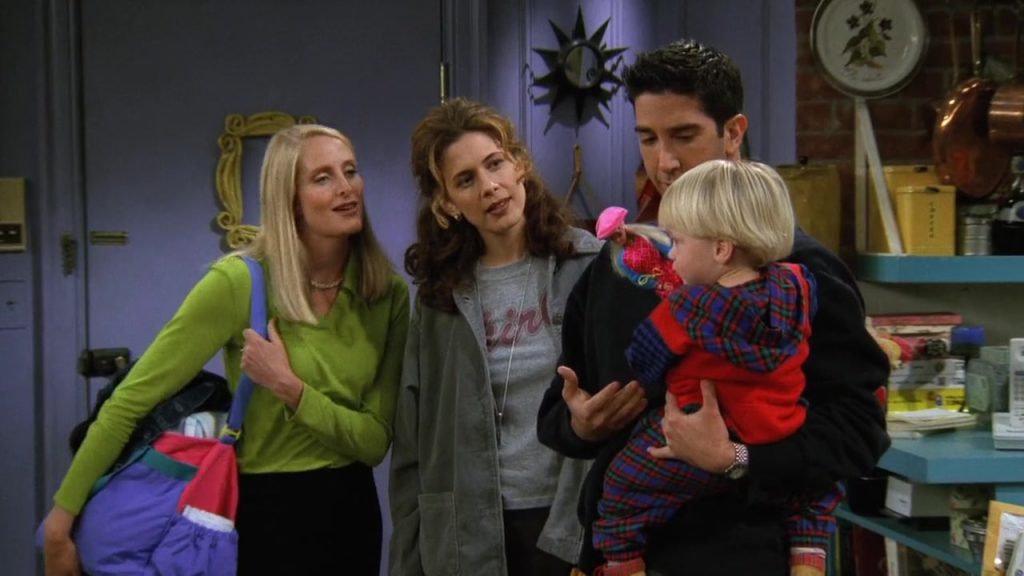
- “Janice: So let’s go to a bad one and make out. [hyena laugh]”
- Scene Description: Janice, one of the recurring characters in Friends, is known for her loud, shrill laugh. In this context, she laughs obnoxiously, resembling the loud laugh of a hyena.
Word Breakdown:
- Definition: A loud, annoying, or distinctive laugh that resembles the sound made by a hyena.
- Part of Speech: Noun
- Pronunciation: /haɪˈiːnə læf/
- Etymology: Hyena is derived from the Greek hýena, and laugh is just the usual meaning.
Contextual Usage:
- Example Sentences:
- “Her hyena laugh was so loud, it made everyone stop talking.”
- “That guy has a hyena laugh; it’s hard to concentrate when he laughs.”
Learning Insights:
- Common Mistake: People might confuse this with just “laughing loudly,” but a hyena laugh is specifically about a particular, often grating tone of laughter.
- Memorization Trick: Imagine a hyena in the wild, laughing loudly and obnoxiously—just like Janice’s laugh!
6. Intrigued
Original Movie Context:
- “Ross: [to Chandler] Are you intrigued?”
- Scene Description: Ross asks Chandler if he’s curious or interested in the idea of the product being advertised on TV. Ross is trying to gauge Chandler’s reaction to the infomercial.
Word Breakdown:
- Definition: To be very interested in something or curious about it.
- Part of Speech: Adjective
- Pronunciation: /ɪnˈtriːɡd/
- Etymology: From the Latin intricari, meaning “to entangle.”
Contextual Usage:
- Example Sentences:
- “I’m intrigued by this new book. I’ll have to check it out.”
- “She was intrigued by the mystery of the missing necklace.”
- Common Collocations: “Intrigued by,” “intrigued to know,” “intrigued about”
Learning Insights:
- Pronunciation Tip: Focus on the second syllable tri (pronounced “tree”).
- Cultural Nuance: When someone says they’re intrigued, it often means they are interested in something with a sense of curiosity, almost like they are puzzled but want to know more.
One of the best ways to reinforce your language skills is through immersion, and learning language with TV series helps you experience authentic conversations in every episode.
7. Tragedy
Original Movie Context:
- “Janice: What is the great tragedy here?”
- Scene Description: Janice is being dramatic (as usual) while trying to lighten the mood after Joey’s missed audition. She’s asking about the “tragedy” of the situation in a sarcastic way.
Word Breakdown:
- Definition: A very sad or disastrous event, typically involving loss or disaster. It can also refer to a genre of drama or literature that deals with serious and sad themes.
- Part of Speech: Noun
- Pronunciation: /ˈtrædʒɪdi/
- Etymology: From the Greek tragōidia, meaning “goat song,” a reference to ancient Greek plays performed at festivals.
Contextual Usage:
- Example Sentences:
- “The sinking of the Titanic was a great tragedy.”
- “Losing my favorite book was a personal tragedy.”
- Common Collocations: “Great tragedy,” “tragic event,” “tragic loss”
Learning Insights:
- Common Mistake: Sometimes people use tragedy too lightly when they are referring to minor issues. True tragedy usually refers to something significant or deeply upsetting.
- Memorization Tip: Think of a tragic movie plot, where something terribly sad happens—this can help you connect the word to its meaning.
Whether you’re a beginner or an advanced learner, learning language with TV series opens up a world of real-life context, making language feel more accessible.
8. Guilty pleasure
Original Movie Context:
- “Phoebe: What a sad little life she must lead.”
- Scene Description: Phoebe sarcastically mocks a situation, using humor to comment on someone’s life. This phrase can often be used to describe something you enjoy but feel slightly ashamed about, like a guilty pleasure.
Word Breakdown:
- Definition: Something that you enjoy doing, even though you might feel embarrassed or ashamed about it.
- Part of Speech: Noun phrase
- Pronunciation: /ˈɡɪlti ˈplɛʒə/
- Etymology: Guilty comes from Old French guilte, meaning “blame.” Pleasure is from Latin placere, meaning “to please.”
Contextual Usage:
- Example Sentences:
- “Watching cheesy reality TV shows is my guilty pleasure.”
- “I know it’s a guilty pleasure, but I can’t help it!”
- Common Collocations: “Guilty pleasure food,” “guilty pleasure TV,” “guilty pleasure song”
Learning Insights:
- Cultural Nuance: Guilty pleasure is a common phrase used to describe something we secretly enjoy, but might not admit to in public due to embarrassment.
- Pronunciation Tip: Emphasize the guilty part to show the conflict between enjoyment and shame.
9. Hang up
Original Movie Context:
- “Phoebe: Oh, I know. [in high-pitched voice] Hi. This is Caitlin, from Phoebe Buffay’s office. Ummm, is Anne there for Phoebe? She’ll know what it’s about. [Joey: Hang up. Hang up right now.]”
- Scene Description: Phoebe, in a humorous moment, calls to pretend to be someone else and tries to get Joey out of a sticky situation. Joey urgently tells her to hang up the phone.
Word Breakdown:
- Definition: To end a phone call. It can also mean to put something in its place, such as clothing on a hook.
- Part of Speech: Phrasal verb
- Pronunciation: /hæŋ ʌp/
- Etymology: Hang comes from Old English hangian, meaning “to suspend.”
Contextual Usage:
- Example Sentences:
- “I have to hang up; I’ll call you back later.”
- “After our conversation, she just hung up without saying goodbye.”
Learning Insights:
- Common Mistake: Some learners confuse hang up with hang on, which means to wait.
- Memorization Tip: Imagine physically hanging up the phone on a hook as you end a conversation.
By watching TV shows you love, learning language with TV series can be both fun and effective, making new vocabulary stick naturally.
10. Bunny-bump
Original Movie Context:
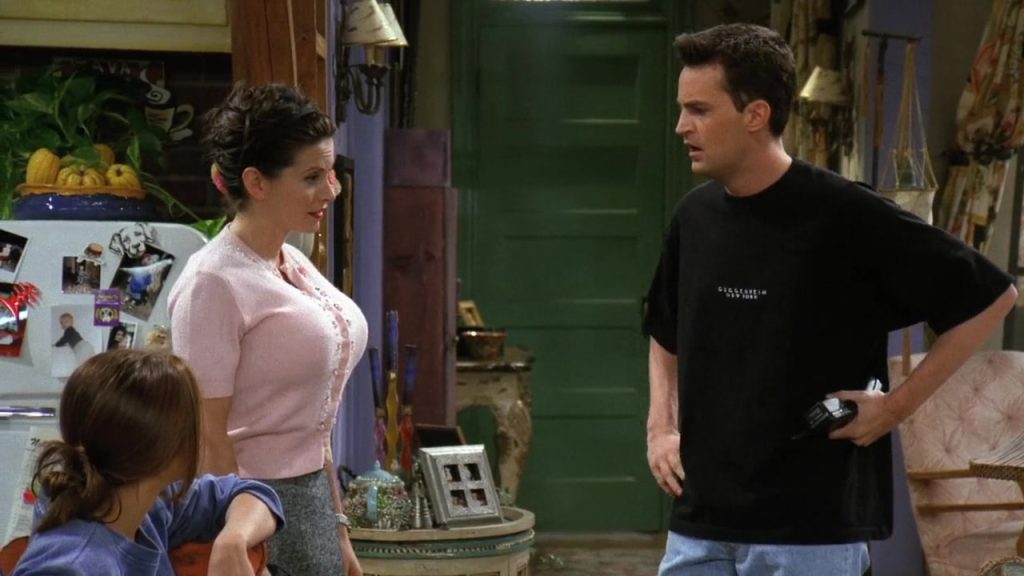
- “Monica: Perhaps you would like me to turn like this, so you can bunny-bump against my back.”
- Scene Description: Monica playfully makes a joke about a way to “bunny-bump” Chandler, referring to a silly or awkward physical interaction between them.
Word Breakdown:
- Definition: A playful or affectionate term, likely invented for this scene. It refers to bumping or touching someone in a cute or playful way.
- Part of Speech: Noun
- Pronunciation: /ˈbʌni bʌmp/
Contextual Usage:
- Example Sentences:
- “We were just bunny-bumping each other while having fun.”
- “She gave me a quick bunny-bump when
If you’re looking for an enjoyable way to improve your language skills, learning language with TV series like Friends is a great option.
How Can Our Extension Help You Learn Vocabulary from Friends?
Learning English with TV series like Friends is not only effective but incredibly fun. With our language learning extension, you can use features like Mouse Dictionary to instantly understand new words while watching the show. Imagine watching Joey miss his chance at an audition and being able to hover over the phrase “missed my chance” to instantly see its meaning. You can also save words you learn for later review with the Save Words feature, making it easier to remember tricky vocabulary.
Fluency Gym, a unique feature in our tool, can help you practice speaking with real dialogue from your favorite shows. You can compare your pronunciation with that of the actors and turn passive vocabulary into active speaking skills.
Previous Articles You Might Like:
- Language Learning with Netflix: Mastering Vocabulary from Friends S01E11
- Learn English via Film: 15 Essential Vocabulary Words from Friends S01 E18
- Mastering Vocabulary with Friends S01E24: An Engaging Film Language Study
- Enhance Your English with Friends S02E07: 12 Essential Vocabulary Words for Netflix Language Learning
Final Thoughts
Learning English with Netflix, especially through series like Friends, can turn a boring study session into an exciting adventure. By focusing on key vocabulary words, idioms, and phrases that come up in the context of the show, you’re not only improving your vocabulary but also learning how to use language in real, conversational ways. Don’t forget, our extension can make this process even easier, offering tools that help you grasp new words and practice speaking with native pronunciation. Ready to dive deeper into language learning? Give it a try!