Learning a new language is a rewarding but often daunting task. While some languages feel relatively easy to pick up, others are notoriously difficult, leaving learners grappling with complex grammar, unfamiliar scripts, and tricky pronunciations. But what exactly makes a language the hardest language to learn? In this article, we’ll explore the key factors that contribute to the difficulty of difficult languages and why some challenging languages feel like climbing a linguistic mountain.
Introduction: Why Are Some Languages Harder Than Others?
The difficulty of learning a language depends on several factors, including your native language, the language’s structure, and its cultural context. For example, an English speaker might find Spanish easier to learn than Mandarin because Spanish shares similarities with English in terms of alphabet and grammar. On the other hand, languages like Arabic or Japanese present unique challenges that can take years to master.
According to the Foreign Service Institute (FSI), languages are categorized into different difficulty levels for English speakers. While Category I languages like Spanish or French take about 600 hours to learn, Category V languages like Mandarin, Arabic, and Korean can take up to 2,200 hours. But what makes these languages so challenging? Let’s break it down.
Key Factors That Make a Language Hard to Learn
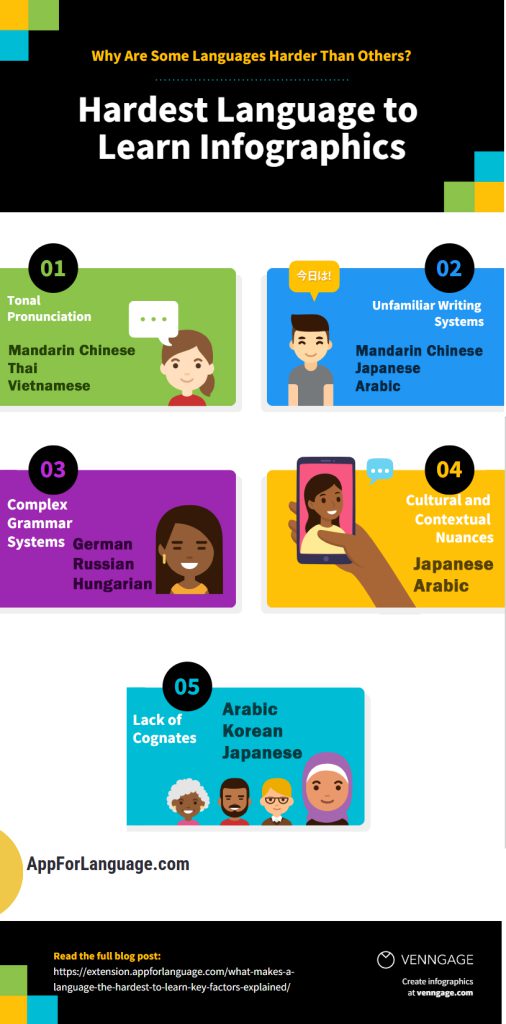
1. Complex Grammar Systems
One of the biggest hurdles in learning difficult languages is mastering their grammar. Some languages have intricate rules that differ significantly from English. For example:
- German: Known for its complex case system (nominative, accusative, dative, and genitive).
- Russian: Uses a system of grammatical gender and six cases for nouns.
- Hungarian: Features 18 cases and a highly agglutinative structure, where words are formed by stringing together morphemes.
These grammatical complexities can overwhelm learners, especially when they don’t exist in their native language.
2. Unfamiliar Writing Systems
Another major challenge is learning a new script. Languages like Mandarin, Japanese, and Arabic use writing systems that are entirely different from the Latin alphabet. For instance:
- Mandarin Chinese: Uses thousands of characters, each representing a word or concept.
- Japanese: Combines three scripts—kanji, hiragana, and katakana—each with its own rules.
- Arabic: Features a cursive script written from right to left, with letters that change shape depending on their position in a word.
These scripts require significant time and effort to master, making these languages some of the hardest languages to learn.
3. Tonal Pronunciation
Tonal languages add another layer of difficulty. In these languages, the meaning of a word can change based on the tone used. For example:
- Mandarin Chinese: Has four tones, and mispronouncing a tone can lead to misunderstandings.
- Thai: Uses five tones, making it challenging for non-native speakers to distinguish between words.
- Vietnamese: Also relies heavily on tones, with six distinct tones in the northern dialect.
For speakers of non-tonal languages, mastering tones can feel like learning an entirely new way of speaking.
4. Lack of Cognates
Cognates are words that share a common origin with words in another language. For example, English and Spanish share many cognates, such as “animal” (animal) and “color” (color). However, languages like Arabic, Korean, and Japanese have few cognates with English, making vocabulary acquisition more challenging.
5. Cultural and Contextual Nuances
Language is deeply tied to culture, and understanding cultural context is crucial for fluency. For example:
- Japanese: Uses honorifics and politeness levels that change based on social hierarchy.
- Arabic: Has formal and informal registers, with Modern Standard Arabic used in writing and regional dialects spoken in daily life.
These cultural nuances can be difficult for learners to grasp, especially if they’re unfamiliar with the culture.
Examples of the Hardest Languages to Learn
Let’s take a closer look at some of the most challenging languages for English speakers:
1. Mandarin Chinese
- Why it’s hard: Tonal system, thousands of characters, and lack of cognates.
- Learning time: Approximately 2,200 hours (FSI).
2. Arabic
- Why it’s hard: Complex grammar, cursive script, and regional dialects.
- Learning time: Approximately 2,200 hours (FSI).
3. Japanese
- Why it’s hard: Three writing systems, complex honorifics, and contextual grammar.
- Learning time: Approximately 2,200 hours (FSI).
4. Korean
- Why it’s hard: Unique grammar structure, honorifics, and sentence endings.
- Learning time: Approximately 2,200 hours (FSI).
5. Hungarian
- Why it’s hard: Agglutinative grammar, 18 cases, and few cognates.
- Learning time: Approximately 1,100 hours (FSI).
Tips for Tackling Difficult Languages
While learning a hardest language to learn can be intimidating, these tips can make the process easier:
- Start with the basics: Focus on mastering the alphabet, pronunciation, and basic grammar before diving into complex topics.
- Immerse yourself: Watch movies, listen to music, and practice speaking.
- Use language apps: Tools like Duolingo, Memrise, and Anki can help with vocabulary and grammar.
- Be patient: Learning a difficult language takes time, so set realistic goals and celebrate small victories.
Conclusion: Is It Worth the Effort?
While difficult languages like Mandarin, Arabic, and Japanese present significant challenges, they also offer immense rewards. Learning a challenging language can open doors to new cultures, career opportunities, and personal growth. By understanding the key factors that make a language hard to learn, you can approach the process with confidence and determination.
So, what’s the hardest language to learn for you? Whether it’s mastering Mandarin tones or decoding Arabic script, the journey is as rewarding as the destination. Happy learning!
FAQs
- What is the hardest language to learn for English speakers?
Mandarin Chinese, Arabic, and Japanese are often considered the hardest due to their complex grammar, writing systems, and pronunciation. - Why are tonal languages so difficult?
Tonal languages require learners to master pitch variations, which can change the meaning of words. This is unfamiliar for speakers of non-tonal languages. - How long does it take to learn a difficult language?
According to the FSI, it can take up to 2,200 hours to achieve proficiency in languages like Mandarin or Arabic.
This article is optimized for SEO with the use of keywords, headings, and a clear structure. It’s also designed for readability with short paragraphs, bullet points, and engaging content. Let me know if you’d like further adjustments!