
Are you passionate about language study movies and eager to enhance your English skills? Look no further! In this article, we dive into Friends S02E12 to uncover 15 essential vocabulary words that will elevate your language learning journey. Whether you’re watching with Language Learning With Netflix or exploring other movie for language strategies, these carefully selected words will make your learning experience both fun and effective.
Vocabulary to Learn in This Article
- Idioms
- Can’t get the monkey off your back
- A jungle out there
- Sometimes monkeys die
- Slang
- Humping
- Wack job
- Boff
- Important Vocabulary
- Paleontology conference
- Capuchan
- Neurosurgeon
- Phrasal Verbs
- Give away
- Run away with
- Turn off
- Engaging Phrases
- Everything seems to work out OK
- You deserve happiness, you deserve love
Let’s explore each of these vocabulary words in detail, using contexts from Friends S02E12 to deepen your understanding.
1. Can’t Get the Monkey Off Your Back
Original Movie Context
Scene: A TV commercial at Monica and Rachel’s apartment.
Commercial Voiceover: “Can’t get the monkey off your back? Then put it in your mouth…”
Scene Description and Emotional Tone: The commercial depicts a stressed-out guy overwhelmed by work, symbolized by a monkey piling papers on his desk. The tone is humorous yet relatable, highlighting common workplace stress.
Word Breakdown
- Definition: An idiom meaning to have a persistent problem or burden that is hard to get rid of.
- Part of Speech: Verb phrase
- Pronunciation: /mʌŋˈki ɔf jʊər bæk/
- Etymology: Originates from the idea of a monkey clinging onto someone’s back, symbolizing an ongoing annoyance.
Contextual Usage
- Example Sentences:
- “He’s been trying to quit smoking for years, but he just can’t get the monkey off his back.”
- “Debt can be a monkey on your back if not managed properly.”
- Formal vs. Informal:
- Informal: “That bad habit is a monkey on your back.”
- Formal: “He struggles with a persistent issue that he cannot easily overcome.”
- Common Collocations:
- Monkey off your back
- Get rid of the monkey
Learning Insights
- Pronunciation Tips: Emphasize the stress on “monkey” and “back” to convey the idiom’s meaning.
- Common Mistakes: Misinterpreting the literal meaning of the idiom instead of understanding its figurative use.
- Cultural Nuances: This idiom is widely used in English-speaking workplaces to describe ongoing challenges.
- Memorization Tricks: Visualize a monkey physically trying to cling onto your back to remember the phrase.
2. A Jungle Out There
Original Movie Context
Scene: The MonkeyShine Beer commercial.
Commercial Voiceover: “…With MonkeyShine Beer, ’cause it’s a jungle out there.”
Scene Description and Emotional Tone: The voiceover compares the chaotic world to a jungle, suggesting that life is wild and unpredictable. The tone is playful yet emphasizes the need for a coping mechanism.
Word Breakdown
- Definition: A phrase implying that the world is chaotic, competitive, or difficult to navigate.
- Part of Speech: Noun phrase
- Pronunciation: /ˈdʒʌŋɡl aʊt ðɛr/
- Etymology: Derived from the natural environment of a jungle, symbolizing wildness and unpredictability.
Contextual Usage
- Example Sentences:
- “Finding a good job these days is a jungle out there.”
- “The dating scene is a jungle out there; good luck navigating it!”
- Formal vs. Informal:
- Informal: “It’s a jungle out there in the tech industry.”
- Formal: “The global market is highly competitive and unpredictable.”
- Common Collocations:
- Jungle out there
- Navigate the jungle
Learning Insights
- Pronunciation Tips: Smoothly connect “jungle” and “out there” to maintain the flow of the idiom.
- Common Mistakes: Taking the phrase literally instead of understanding its metaphorical meaning.
- Cultural Nuances: Often used to describe challenging environments, particularly in careers or social settings.
- Memorization Tricks: Imagine the world as a dense, wild jungle to grasp the metaphor.
3. Humping Everything in Sight
Original Movie Context
Scene: Rachel discussing Marcel.
Rachel: “Oh, Ross, you had to, I mean, he was humping everything in sight.”
Scene Description and Emotional Tone: Rachel humorously describes Marcel’s (the monkey) overly affectionate behavior. The tone is light-hearted and funny.
Word Breakdown
- Definition: Slang for engaging in sexual activities frequently or indiscriminately.
- Part of Speech: Verb (slang)
- Pronunciation: /ˈhʌmpɪŋ ˈɛvrɪθɪŋ ɪn saɪt/
- Etymology: Derived from “hump,” a colloquial term for sexual intercourse.
Contextual Usage
- Example Sentences:
- “Ever since he started dating, he’s been humping everyone at the party.”
- “The playful dog was humping everything in sight.”
- Formal vs. Informal:
- Informal: “He’s always humping around at social gatherings.”
- Formal: “He tends to engage in relationships frequently and indiscriminately.”
- Common Collocations:
- Humping around
- Humping everything
Learning Insights
- Pronunciation Tips: Ensure clarity on the “h” sound to differentiate from similar-sounding words.
- Common Mistakes: Confusing “humping” with “jumping” or other similar-sounding verbs.
- Cultural Nuances: This slang is often used humorously or informally to describe excessive affectionate behavior.
- Memorization Tricks: Associate the word with a playful or humorous image to remember its slang meaning.
Language study movies provide context for how words and phrases are used, making it easier to apply them correctly in conversations.
4. Wack Job
Original Movie Context
Scene: Chandler describing Erica.
Chandler: “Oh no no no, she’s a total wack job.”
Scene Description and Emotional Tone: Chandler refers to Erica as unstable or crazy. The tone is dismissive and slightly mocking.
Word Breakdown
- Definition: Slang for someone who is crazy or behaves irrationally.
- Part of Speech: Noun (slang)
- Pronunciation: /wæk dʒɑb/
- Etymology: “Wack” is slang for something bad or crazy, combined with “job” to label a person.
Contextual Usage
- Example Sentences:
- “Don’t trust him; he’s a wack job.”
- “She left her wack job to pursue her passion for art.”
- Formal vs. Informal:
- Informal: “He’s acting like a wack job today.”
- Formal: “She is behaving irrationally and unpredictably.”
- Common Collocations:
- Total wack job
- Act like a wack job
Learning Insights
- Pronunciation Tips: Emphasize the “w” sound in “wack” to convey the negative connotation.
- Common Mistakes: Mispronouncing “wack” as “walk” or confusing “job.”
- Cultural Nuances: This term is informal and can be offensive if used inappropriately; best reserved for casual conversations.
- Memorization Tricks: Think of “wack” as “whacky” to remember its meaning related to craziness.
Listening to native speakers in language study movies helps you improve your pronunciation and intonation naturally.

5. Paleontology Conference
Original Movie Context
Scene: Ross discussing his trip.
Ross: “Well, there’s this, uh, paleontology conference in L.A…”
Scene Description and Emotional Tone: Ross mentions attending a professional gathering related to his field. The tone is informative and slightly hesitant.
Word Breakdown
- Definition: A professional gathering focused on the study of fossils and ancient life forms.
- Part of Speech: Noun phrase
- Pronunciation: /ˌpæliəˈɑn.tə.lə.dʒi ˈkɑn.fər.ənss/
- Etymology: “Paleontology” combines Greek words “palaios” (ancient) and “ontologia” (study of being).
Contextual Usage
- Example Sentences:
- “She presented her latest findings at the paleontology conference.”
- “The paleontology conference attracts experts from around the world.”
- Formal vs. Informal:
- Formal: “He is attending the international paleontology conference this summer.”
- Informal: “Ross is going to a dinosaur conference in LA.”
- Common Collocations:
- Attend a paleontology conference
- Paleontology conference presentation
Learning Insights
- Pronunciation Tips: Break down the word into syllables: pa-le-on-to-lo-gy con-fer-ence.
- Common Mistakes: Mispronouncing the middle syllables or skipping parts of the word.
- Cultural Nuances: Recognizing the importance of professional conferences in academic and scientific communities.
- Memorization Tricks: Associate “paleo” with “ancient” and “conference” with a professional meeting to remember the term.
Language study movies make language learning accessible and fun, breaking away from the monotony of textbooks and exercises.
6. Capuchan
Original Movie Context
Scene: Ross referring to Marcel.
Ross: “…he’s a capuchan, answers to the name Marcel.”
Scene Description and Emotional Tone: Ross specifies the type of monkey he owns, adding clarity to the conversation. The tone is factual and informative.
Word Breakdown
- Definition: A capuchin is a type of small monkey known for its intelligence and dexterity.
- Part of Speech: Noun
- Pronunciation: /kəˈpjuːkən/
- Etymology: Named after the Capuchin friars, reflecting the monkey’s coloring.
Contextual Usage
- Example Sentences:
- “Capuchin monkeys are highly intelligent and often used in research.”
- “She saw a capuchin swinging through the trees at the zoo.”
- Formal vs. Informal:
- Formal: “The capuchin is recognized for its problem-solving abilities.”
- Informal: “Look at that cute capuchin climbing the fence!”
- Common Collocations:
- Capuchin monkey
- Intelligent capuchin
Learning Insights
- Pronunciation Tips: Emphasize the “chu” sound in “capuchin” to avoid mispronunciation.
- Common Mistakes: Confusing “capuchin” with similar-sounding animals like “cappuccino.”
- Cultural Nuances: Capuchin monkeys are often featured in media for their playful nature.
- Memorization Tricks: Link “capuchin” with “cute and clever” to remember their characteristics.
Watching language study movies can keep you motivated by showing practical applications of the language you’re learning.
7. Neurosurgeon
Original Movie Context
Scene: Erica addressing Joey.
Erica: “Well, yes, yes, the best doctor in all of Salem, Dr. Drake Remore.”
Scene Description and Emotional Tone: Erica mistakenly believes Joey is a neurosurgeon, leading to humorous confusion. The tone is flirty and comedic.
Word Breakdown
- Definition: A highly specialized surgeon who operates on the nervous system, including the brain and spinal cord.
- Part of Speech: Noun
- Pronunciation: /ˌnjʊə.roʊˈsɜː.dʒən/
- Etymology: Combines “neuro” (related to nerves) and “surgeon” (a medical professional who performs surgery).
Contextual Usage
- Example Sentences:
- “Becoming a neurosurgeon requires many years of rigorous training.”
- “The neurosurgeon successfully removed the tumor without complications.”
- Formal vs. Informal:
- Formal: “She is a renowned neurosurgeon at the metropolitan hospital.”
- Informal: “My uncle is a neurosurgeon; he works with brain surgeries.”
- Common Collocations:
- Board-certified neurosurgeon
- Experienced neurosurgeon
Learning Insights
- Pronunciation Tips: Stress the second syllable: neu-RO-surgeon.
- Common Mistakes: Misplacing the stress or shortening the word.
- Cultural Nuances: Neurosurgeons are often portrayed in media as highly skilled and important medical professionals.
- Memorization Tricks: Break down the word into “neuro” (nerves) + “surgeon” (doctor) to remember the role.
The engaging storylines of language study movies make it easier to remember and retain new vocabulary words.
8. Boff
Original Movie Context
Scene: Chandler describing Erica’s intentions.
Chandler: “He’s the one who wants to boff the maniac.”
Scene Description and Emotional Tone: Chandler uses slang to humorously describe Erica’s desire. The tone is sarcastic and playful.
Word Breakdown
- Definition: Slang for having sex.
- Part of Speech: Verb (slang)
- Pronunciation: /bɒf/
- Etymology: Originates from British slang, popularized in informal speech.
Contextual Usage
- Example Sentences:
- “They’ve been dating for a while; I think it’s time they boff.”
- “He joked that if they ever met, they’d probably boff.”
- Formal vs. Informal:
- Informal: “They decided to boff after the party.”
- Formal: “They chose to become intimate following their relationship.”
- Common Collocations:
- Boff someone
- Want to boff
Learning Insights
- Pronunciation Tips: Keep it short and punchy, emphasizing the “b” sound.
- Common Mistakes: Using it in formal contexts where it’s inappropriate.
- Cultural Nuances: This slang is considered crude and should be used cautiously, mainly in informal settings.
- Memorization Tricks: Link “boff” with playful or humorous situations to remember its slang meaning.
Language study movies serve as an excellent supplementary tool alongside traditional study methods, offering a well-rounded learning experience.

9. Give Away
Original Movie Context
Scene: Ross reflecting on Marcel.
Ross: “Sometimes I wonder if I did the right thing, ya know, giving him away.”
Scene Description and Emotional Tone: Ross contemplates whether releasing Marcel was the right decision. The tone is reflective and emotional.
Word Breakdown
- Definition: To release someone from your care or ownership, often referring to pets or possessions.
- Part of Speech: Phrasal verb
- Pronunciation: /ɡɪv əˈweɪ/
- Etymology: Combines “give” with “away” to indicate transferring ownership.
Contextual Usage
- Example Sentences:
- “She decided to give away her old clothes to charity.”
- “They had to give away their car after the accident.”
- Formal vs. Informal:
- Formal: “He chose to give away his estate to his children.”
- Informal: “I’m going to give away my books to the library.”
- Common Collocations:
- Give away something
- Decide to give away
Learning Insights
- Pronunciation Tips: Ensure clarity on both words, especially the stress on “give.”
- Common Mistakes: Misusing it as a single verb instead of a phrasal verb.
- Cultural Nuances: Often used in the context of charity or emotional decisions involving possessions.
- Memorization Tricks: Visualize handing something away to remember the phrase.
Whether you’re at home or on the go, language study movies offer a flexible way to enhance your language skills whenever you have free time.
10. Run Away With
Original Movie Context
Scene: Monica discussing Joey’s potential relationship.
Monica: “He can not pursue this.”
Scene Description and Emotional Tone: Monica expresses concern over Joey’s involvement with Erica. The tone is worried and protective.
Word Breakdown
- Definition: To elope or escape with someone, typically in a romantic context.
- Part of Speech: Phrasal verb
- Pronunciation: /rʌn əˈweɪ wɪð/
- Etymology: Combines “run” with “away” and “with” to indicate leaving together.
Contextual Usage
- Example Sentences:
- “They decided to run away with each other and travel the world.”
- “He threatened to run away with her if she didn’t agree to his terms.”
- Formal vs. Informal:
- Informal: “Let’s run away with just the two of us.”
- Formal: “They chose to elope and run away together.”
- Common Collocations:
- Run away with someone
- Plan to run away with
Learning Insights
- Pronunciation Tips: Smoothly connect all parts, especially “away with.”
- Common Mistakes: Omitting “with” or misplacing the stress.
- Cultural Nuances: Often associated with romantic or impulsive actions in storytelling.
- Memorization Tricks: Imagine a romantic getaway to remember the phrase.
Language study movies provide valuable cultural insights, helping you understand the nuances and contexts in which certain phrases are used.
11. Everything Seems to Work Out OK
Original Movie Context
Scene: Joey explaining the commercial.
Joey: “Yeah, but then the guy opens his beer and those girls run at him, so, everything seems to work out OK.”
Scene Description and Emotional Tone: Joey describes how the commercial shows a happy ending, making problems disappear. The tone is optimistic and explanatory.
Word Breakdown
- Definition: A phrase expressing that despite initial problems, the situation resolves positively.
- Part of Speech: Sentence (phrase)
- Pronunciation: /ˈɛvrɪθɪŋ ˈsiːmz tə wɜrk aʊt oʊˈkeɪ/
- Etymology: Combines general terms to convey resolution and positivity.
Contextual Usage
- Example Sentences:
- “I was worried about the meeting, but everything seems to work out OK now.”
- “Despite the delays, everything seems to work out OK in the end.”
- Formal vs. Informal:
- Informal: “It was a rough start, but everything seems to work out OK.”
- Formal: “Although there were challenges, the project appears to be resolving satisfactorily.”
- Common Collocations:
- Work out OK
- Everything works out
Learning Insights
- Pronunciation Tips: Maintain a steady rhythm, emphasizing “work out OK” to highlight resolution.
- Common Mistakes: Misusing “work out” in contexts where “resolve” might be more appropriate.
- Cultural Nuances: Commonly used in everyday conversations to reassure or express relief.
- Memorization Tricks: Think of “everything works out” as a reassuring mantra to remember the phrase.
Watching language study movies allows you to see and hear words in action, reinforcing your understanding through real-life scenarios.
12. You Deserve Happiness, You Deserve Love
Original Movie Context
Scene: Chandler comforting Joey.
Chandler: “What’re you lookin’ at me for? He’s the one who wants to boff the maniac.”
Scene Description and Emotional Tone: Chandler encourages Joey to pursue happiness despite the awkward situation. The tone is supportive and uplifting.
Word Breakdown
- Definition: Encouraging someone to seek happiness and love, affirming their worthiness.
- Part of Speech: Sentence (phrase)
- Pronunciation: /ju dɪˈzɜrv ˈhæpɪnəs, ju dɪˈzɜrv lʌv/
- Etymology: Simple construction using “deserve” to convey worthiness.
Contextual Usage
- Example Sentences:
- “After everything you’ve been through, you deserve happiness and love.”
- “Don’t settle for less; you deserve happiness and love.”
- Formal vs. Informal:
- Informal: “You totally deserve happiness and love.”
- Formal: “You rightfully deserve both happiness and love.”
- Common Collocations:
- Deserve happiness
- Deserve love
Learning Insights
- Pronunciation Tips: Stress “deserve” to emphasize the affirmation.
- Common Mistakes: Misplacing the verb or using it in incorrect contexts.
- Cultural Nuances: Often used in supportive conversations to uplift someone’s spirits.
- Memorization Tricks: Associate the phrase with acts of kindness and support to remember its usage.
Language study movies like Friends S02E12 offer relatable contexts that help you grasp new vocabulary effortlessly.
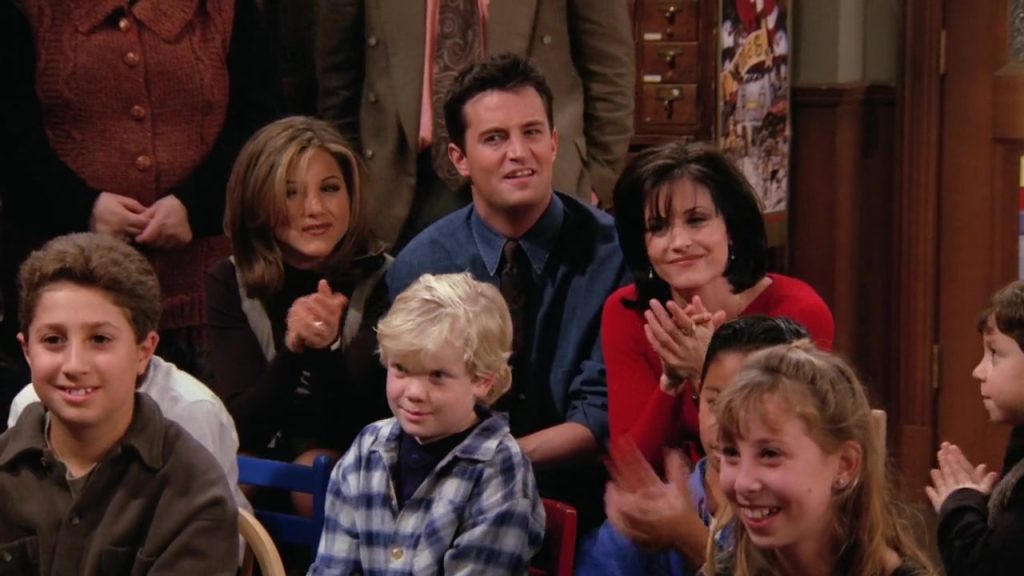
13. Turn Off
Original Movie Context
Scene: Joey urging others.
Joey: “Oh my God, quick turn off the TV.”
Scene Description and Emotional Tone: Joey asks to turn off the TV to prevent Erica from seeing the situation on screen. The tone is urgent and panicked.
Word Breakdown
- Definition: To deactivate or stop the operation of something, such as a device.
- Part of Speech: Phrasal verb
- Pronunciation: /tɜrn ɔf/
- Etymology: Combines “turn” with “off” to indicate stopping the functioning of something.
Contextual Usage
- Example Sentences:
- “Please turn off the lights when you leave the room.”
- “Don’t forget to turn off the oven after baking.”
- Formal vs. Informal:
- Informal: “Can you turn off the music?”
- Formal: “Kindly ensure the equipment is turned off after use.”
- Common Collocations:
- Turn off something
- Quickly turn off
Learning Insights
- Pronunciation Tips: Keep “turn” and “off” distinct but smoothly connected.
- Common Mistakes: Misplacing the particles, e.g., “turn something off” vs. “turn off something.”
- Cultural Nuances: Used in various contexts, from everyday household tasks to professional settings.
- Memorization Tricks: Visualize flipping a switch to turn something off, reinforcing the action.
Incorporating language study movies into your daily routine can make learning English more enjoyable and effective.
Machine Translation for Languages Without Subtitles
Original Movie Context
Scene: Description of the language learning extension’s features.
Word Breakdown
- Definition: The use of software to automatically translate text from one language to another, especially for languages lacking official subtitles.
- Part of Speech: Noun phrase
- Pronunciation: /məˈʃiːn trænsˈleɪʃən fɔr ˈlæŋɡwɪdʒəz wɪˈðaʊt ˈsʌbˌtaɪtlz/
- Etymology: Combines “machine” with “translation,” indicating automated processes.
Contextual Usage
- Example Sentences:
- “Machine translation can be a helpful tool for understanding foreign films.”
- “For languages without subtitles, machine translation bridges the gap.”
- Formal vs. Informal:
- Formal: “Machine translation services are essential for multilingual content accessibility.”
- Informal: “Using machine translation helps when there are no subtitles available.”
- Common Collocations:
- Machine translation tools
- Automated machine translation
Learning Insights
- Pronunciation Tips: Clearly articulate each word, especially “translation.”
- Common Mistakes: Misunderstanding the scope of machine translation as only literal word-for-word translation.
- Cultural Nuances: Essential for language learning tools, making content accessible across different languages.
- Memorization Tricks: Associate machine translation with translating movie subtitles to remember its relevance in language learning.
Fluency Gym: Your Path to Mastering a Language
Original Movie Context
Scene: Description of the language learning extension’s features.
Word Breakdown
- Definition: An innovative feature designed to elevate reading, listening, and speaking skills through interactive movie dialogues.
- Part of Speech: Noun phrase
- Pronunciation: /ˈfluːənsi dʒɪm/
- Etymology: Combines “fluency” with “gym,” suggesting a workout for language skills.
Contextual Usage
- Example Sentences:
- “Fluency Gym helps learners practice speaking with real-time movie dialogues.”
- “Using Fluency Gym, you can turn passive vocabulary into active language skills.”
- Formal vs. Informal:
- Formal: “Fluency Gym provides an immersive tool for language acquisition.”
- Informal: “With Fluency Gym, language learning feels like a fun workout.”
- Common Collocations:
- Use Fluency Gym
- Fluency Gym feature
Learning Insights
- Pronunciation Tips: Smoothly connect “fluency” and “gym” to reflect the integrated tool.
- Common Mistakes: Mispronouncing “fluency” as “fluent sea.”
- Cultural Nuances: Emphasizes active participation and interactive learning, aligning with modern educational trends.
- Memorization Tricks: Imagine a gym where instead of physical exercises, you’re working out your language skills.
Language Learning Tools to Enhance Your Learning
Incorporating these vocabulary words from Friends S02E12 into your daily conversations can significantly boost your language proficiency. To make the most of language study movies, consider using our innovative language learning extension at AppForLanguage.com. With features like Mouse Dictionary, you can hover over unfamiliar words for instant definitions, making learning seamless as you watch your favorite shows.
Imagine watching Friends S02E12 with our Display Second Subtitle feature, allowing you to compare English with your native language in real-time. Or use the Fluency Gym to actively engage with the dialogue, turning passive watching into an interactive language workout. These tools not only enhance your learning but also make it enjoyable and effective.
Check Out Our Previous Articles
Expand your vocabulary even further by exploring our previous articles:
- Language Learning with Netflix: 15 Essential Vocabulary Words from Friends S01E12
- Boost Your English with Friends S01E19: 12 Essential Vocabulary Words from Film-Based Language Learning
- Mastering Vocabulary with Friends S02E02: Unlock Movie-Based Language Learning
- Mastering English Vocabulary with Friends S02E06: Fun Lessons from Central Perk
Each article is designed to provide you with context-rich vocabulary lessons, leveraging the power of movie for language learning.
Embrace Technology in Your Language Journey
Technology can transform the way you learn languages, making it more interactive and personalized. Our language learning extension offers a suite of features to support your studies:
- Auto-Pause and Play with Button After Each Sentence: Control playback effortlessly, ensuring you understand each sentence before moving on.
- Save Words: Keep track of new vocabulary and review them later with ease.
- Word Pronunciation: Hear the correct pronunciation of any word, enhancing your speaking skills.
These tools integrate naturally into your learning process, helping you build a robust vocabulary while enjoying language study movies like Friends S02E12.
Conclusion
Learning English through language study movies like Friends S02E12 offers a dynamic and enjoyable way to expand your vocabulary. By understanding idioms, slang, and important vocabulary in context, you can significantly improve your language skills. Remember to leverage tools like our language learning extension to make your learning journey even more effective and engaging.
Ready to take your language learning to the next level? Visit AppForLanguage.com today and explore how our unique features, including Fluency Gym, can transform your study routine. Embrace the adventure of learning English through movies and watch your fluency soar!
Discover more ways to enhance your language skills with our innovative tools and engaging content. Happy learning!