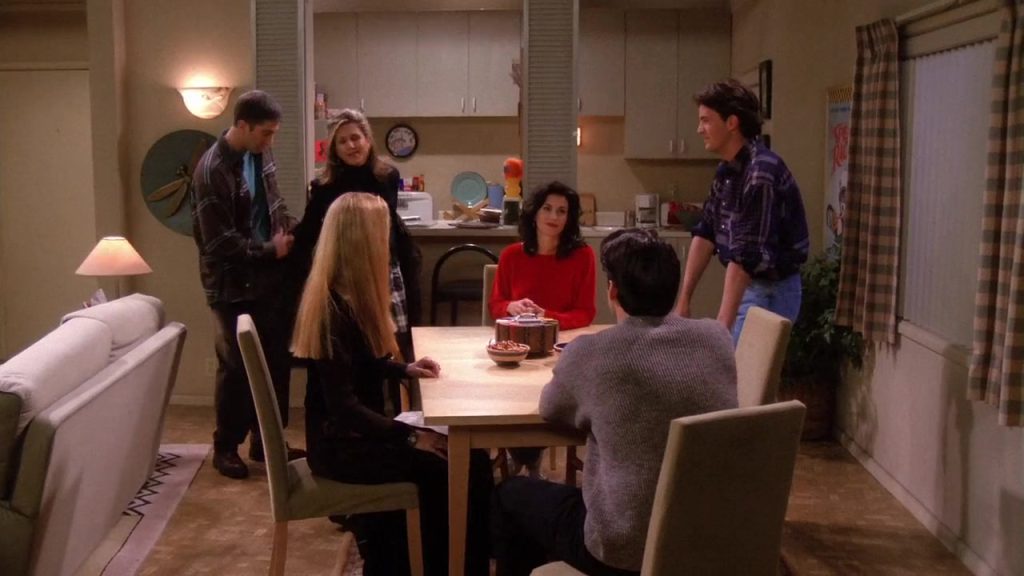
Are you eager to learn English via film and make your language journey both fun and effective? Look no further! Using iconic scenes from Friends S01 E18, this article introduces 15 essential vocabulary words that will boost your English skills. Plus, discover how our innovative language learning extension, Funfluen, can enhance your cinematic English study experience.
1. Resume
Original Movie Context
Rachel: “Hey, look, you guys, I’m going for anything here, OK? I cannot be a waitress anymore, I mean it. I’m sick of the lousy tips, I’m sick of being called ’Excuse me…’”
Scene Description: Rachel is frustrated while helping her friends mail out resumes, feeling stuck in her job as a waitress.
Word Breakdown
- Definition: A document used to apply for jobs, outlining one’s work experience, education, and skills.
- Part of Speech: Noun
- Pronunciation: /rɪˈzjuːmeɪ/
- Etymology: Derived from the French word “résumé,” meaning “summary.”
Examples:
- She updated her resume before applying for the new position.
- Make sure your resume highlights your best achievements.
Contextual Usage
- Formal: “Please attach your resume when submitting the application.”
- Informal: “I need to polish my resume before the job fair.”
- Collocations: Job resume, update resume, submit resume.
Learning Insights
- Pronunciation Tip: Emphasize the second syllable: re-ZU-me.
- Common Mistake: Mispronouncing it as “res-oo-may” instead of “rez-oo-may.”
- Memorization Trick: Think of your resume as the “summary” of your career.
With Funfluen, you can save “resume” and review it anytime while watching Friends.
2. Proofread
Original Movie Context
Ross: “Rach, did you proofread these?”
Scene Description: Ross is ensuring Rachel has checked her resumes for any errors before sending them out.
Word Breakdown
- Definition: To read and correct written material for errors.
- Part of Speech: Verb
- Pronunciation: /ˈpruːfˌriːd/
- Etymology: Combines “proof” and “read,” originally referring to preparing printed material.
Examples:
- Don’t forget to proofread your essay before submission.
- She spent the afternoon proofreading her report for mistakes.
Contextual Usage
- Formal: “Please proofread the contract carefully.”
- Informal: “I need to proofread my text before sending it.”
- Collocations: Proofread a document, proofread thoroughly, proofread for errors.
Learning Insights
- Pronunciation Tip: Stress the first syllable: PROOF-read.
- Common Mistake: Misplacing the stress on the second syllable.
- Memorization Trick: Think of “proof” as ensuring everything is correct.
Use Funfluen’s Mouse Dictionary to instantly see the definition of “proofread” while enjoying your favorite episodes. If you’re looking to make your study sessions more enjoyable, why not try to learn English via film?
3. Bluffing
Original Movie Context
Joey: “Heh… I was bluffing.”
Scene Description: Joey admits he was pretending to have a better poker hand to deceive his friends.
Word Breakdown
- Definition: Pretending to have a stronger position or better cards in a game to deceive others.
- Part of Speech: Verb (gerund)
- Pronunciation: /ˈblʌfɪŋ/
- Etymology: Originates from the word “bluff,” meaning to deceive or mislead.
Examples:
- He’s good at bluffing in poker.
- Don’t try bluffing me; I know the truth.
Contextual Usage
- Formal: “The negotiator was skilled at bluffing to get better terms.”
- Informal: “She was just bluffing when she said she didn’t like the gift.”
- Collocations: Bluffing in poker, bluffing strategy, bluffing attempt.
Learning Insights
- Pronunciation Tip: Short “u” sound: BLUFF-ing.
- Common Mistake: Pronouncing it as “blooming.”
- Memorization Trick: Imagine holding a strong hand to bluff your opponents.
Using popular shows like Friends allows you to learn English via film while having fun. With Funfluen’s Save Words feature, you can save “bluffing” and practice using it in different contexts.
4. Competitive
Original Movie Context
Monica: “Yeah, I know. He can get really competitive.”
Scene Description: Monica acknowledges Ross’s competitive nature during their poker game.
Word Breakdown
- Definition: Having a strong desire to be more successful than others.
- Part of Speech: Adjective
- Pronunciation: /kəmˈpɛtɪtɪv/
- Etymology: From the Latin “competitivus,” meaning “striving to compete.”
Examples:
- She thrives in a competitive environment.
- Their team is very competitive this season.
Contextual Usage
- Formal: “The competitive market requires innovative strategies.”
- Informal: “He’s so competitive; he wants to win everything.”
- Collocations: Competitive advantage, competitive spirit, competitive nature.
Learning Insights
- Pronunciation Tip: Stress the second syllable: com-PET-i-tive.
- Common Mistake: Misplacing the stress on the first syllable.
- Memorization Trick: Think of “competition” to remember the meaning.
To truly grasp conversational English, many learners choose to learn English via film. Funfluen’s Sidebar Display lets you see “competitive” and related words easily while you watch Friends.
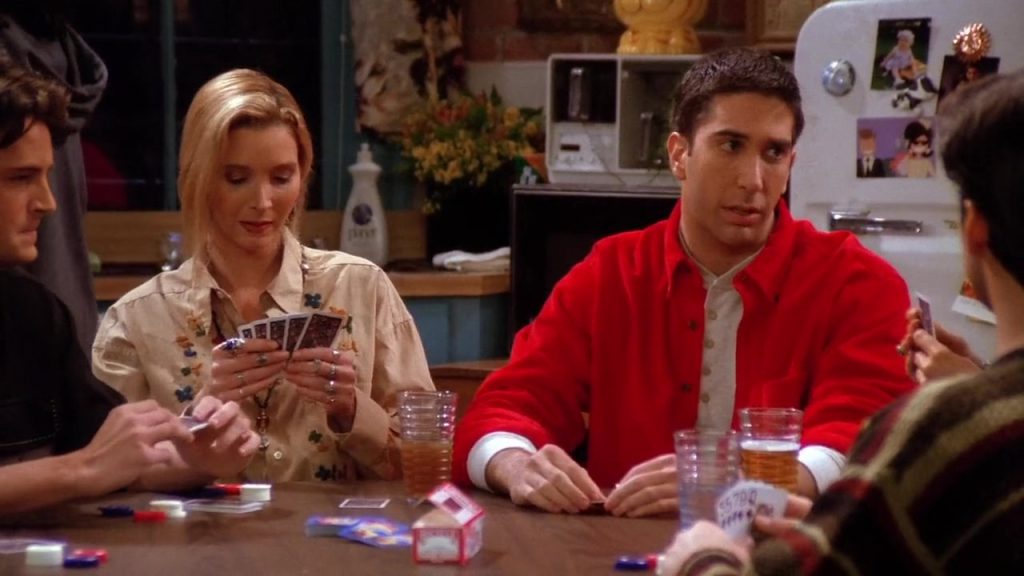
5. Sarcastic
Original Movie Context
Chandler: “…little playthings with yarn?”
Scene Description: Chandler responds sarcastically to Ross’s romantic gestures, highlighting his playful teasing.
Word Breakdown
- Definition: Using irony to mock or convey contempt.
- Part of Speech: Adjective
- Pronunciation: /sɑːrˈkæstɪk/
- Etymology: From “sarcasm,” derived from the Greek “sarkazein,” meaning “to tear flesh.”
Examples:
- Her sarcastic comments often hide her true feelings.
- He made a sarcastic remark about the weather.
Contextual Usage
- Formal: “The speaker’s sarcastic tone undermined his message.”
- Informal: “Oh, great, another meeting. So sarcastic of you.”
- Collocations: Sarcastic remark, sarcastic tone, sarcastic comment.
Learning Insights
- Pronunciation Tip: Emphasize the second syllable: sar-CAS-tic.
- Common Mistake: Pronouncing it as “sarkastick.”
- Memorization Trick: Associate “sarcasm” with irony to grasp the meaning.
Incorporating scenes from Friends is a fantastic way to learn English via film and understand cultural references. Use Funfluen’s Machine Translation to understand “sarcastic” in different contexts across languages.
6. Crudites
Original Movie Context
Monica: “We’ve got salmon roulettes and assorted crudites.”
Scene Description: Monica offers healthy snacks during the poker game, showcasing her culinary skills.
Word Breakdown
- Definition: An assortment of raw vegetables served with a dip.
- Part of Speech: Noun (plural)
- Pronunciation: /kruːˈdiːtiːz/
- Etymology: From French “crudités,” meaning “raw things.”
Examples:
- She prepared a platter of crudites for the party.
- Crudites are a great healthy snack option.
Contextual Usage
- Formal: “The appetizer included crudites with a variety of dips.”
- Informal: “I love snacking on crudites with hummus.”
- Collocations: Serve crudites, plate of crudites, variety of crudites.
Learning Insights
- Pronunciation Tip: Emphasize the second syllable: cru-DEE-teez.
- Common Mistake: Pronouncing it as “cru-dee-ties.”
- Memorization Trick: Think of “raw veggies” to remember “crudites.”
For those who prefer an immersive approach, learning English via film can be both effective and entertaining. With Funfluen’s Display First Subtitle feature, you can see “crudites” clearly and understand its usage.
7. Rematch
Original Movie Context
Monica: “We want a rematch.”
Scene Description: Monica insists on playing another round of poker to settle scores after the first game.
Word Breakdown
- Definition: A second game or match played to resolve a previous contest.
- Part of Speech: Noun
- Pronunciation: /ˈriːmætʃ/
- Etymology: From “re-” meaning “again” and “match.”
Examples:
- After losing the first game, they scheduled a rematch.
- The team is eager for a rematch next week.
Contextual Usage
- Formal: “The championship rematch drew a large audience.”
- Informal: “Let’s have a rematch and see who wins this time.”
- Collocations: Schedule a rematch, demand a rematch, agree to a rematch.
Learning Insights
- Pronunciation Tip: Stress the first syllable: RE-match.
- Common Mistake: Adding an extra syllable, like “re-mat-ch.”
- Memorization Trick: Associate “rematch” with “another match.”
By choosing to learn English via film, you can enhance your listening skills with real-life dialogues. Funfluen’s Save Words feature allows you to save “rematch” for future practice.
8. Fold
Original Movie Context
Chandler: “Couldn’t be more out.”
Ross: “Oh, you’re… [lays down cards]”
Scene Description: Ross decides to fold his hand in poker, conceding the game to Rachel.
Word Breakdown
- Definition: To withdraw from a round of betting in a card game because you think your hand is not strong enough.
- Part of Speech: Verb
- Pronunciation: /fəʊld/
- Etymology: From Old English “fealdan,” meaning “to bend or fold.”
Examples:
- She decided to fold after seeing his strong hand.
- Don’t fold too early; you might still have a chance to win.
Contextual Usage
- Formal: “He chose to fold when the stakes became too high.”
- Informal: “I think I’ll fold this hand; it’s not worth the risk.”
- Collocations: Fold a hand, fold early, fold in poker.
Learning Insights
- Pronunciation Tip: Pronounce it as “fōld,” rhyming with “gold.”
- Common Mistake: Mispronouncing as “fald.”
- Memorization Trick: Imagine folding your cards to remember the meaning.
Our extension makes it easier than ever to learn English via film by providing instant definitions and translations. Funfluen’s Mouse Dictionary lets you hover over “fold” to see its definition instantly.
9. Exasperation
Original Movie Context
Rachel: “Oh, my Goood! Oh, do you think it’s on all of them?”
Scene Description: Rachel expresses exasperation when Ross questions her resumes, showing her frustration.
Word Breakdown
- Definition: A feeling of intense irritation or annoyance.
- Part of Speech: Noun
- Pronunciation: /ɪɡˌzæspəˈreɪʃən/
- Etymology: From Latin “exasperare,” meaning “to make rough or harsh.”
Examples:
- He spoke with exasperation after hearing the same excuse repeatedly.
- Her exasperation was evident in her raised voice.
Contextual Usage
- Formal: “She reacted with exasperation to the repeated delays.”
- Informal: “I could see the exasperation on his face.”
- Collocations: Show exasperation, feel exasperation, express exasperation.
Learning Insights
- Pronunciation Tip: Break it down: ex-as-PER-a-tion.
- Common Mistake: Mispronouncing “per” as “pure.”
- Memorization Trick: Link “exasperation” with “exasperated feelings.”
Imagine learning English via film while watching your favorite episodes of Friends—it’s that simple with our tool. Use Funfluen’s Save Words to keep track of “exasperation” and reinforce your understanding.

10. Gesture
Original Movie Context
Monica: “That was not an incident! I-I was gesturing, a-and the plate slipped out of my hand.”
Scene Description: Monica explains that her actions were just gesturing and not intentional mishaps during the poker game.
Word Breakdown
- Definition: A movement of part of the body, especially a hand or the head, to express an idea or meaning.
- Part of Speech: Verb/Noun
- Pronunciation: /ˈdʒɛstʃər/
- Etymology: From Latin “gestus,” meaning “a gesture.”
Examples:
- He made a gesture to indicate he was ready to start.
- She gestured towards the exit to show where to go.
Contextual Usage
- Formal: “The speaker used a gesture to emphasize his point.”
- Informal: “She gestured excitedly while telling her story.”
- Collocations: Make a gesture, use a gesture, expressive gesture.
Learning Insights
- Pronunciation Tip: Emphasize the first syllable: JES-ture.
- Common Mistake: Pronouncing it as “gester.”
- Memorization Trick: Visualize someone using their hands to remember “gesture.”
Many intermediate learners find that learning English via film helps bridge the gap between textbook knowledge and real-world usage. With Funfluen’s Word Pronunciation feature, practice saying “gesture” correctly while watching Friends.
11. Incidence
Original Movie Context
Rachel: “I got an interview! I got an interview!”
Scene Description: Rachel is ecstatic about getting a job incidence, celebrating her success.
Word Breakdown
- Definition: The occurrence, rate, or frequency of a disease, crime, or other undesirable things.
- Part of Speech: Noun
- Pronunciation: /ˈɪnsɪdəns/
- Etymology: From Latin “incidere,” meaning “to fall upon.”
Examples:
- The incidence of flu increases during winter.
- There is a high incidence of accidents on that road.
Contextual Usage
- Formal: “The incidence of cybercrime has been rising steadily.”
- Informal: “There’s been an incidence of power outages lately.”
- Collocations: High incidence, incidence rate, report an incidence.
Learning Insights
- Pronunciation Tip: Emphasize the first syllable: IN-sid-ence.
- Common Mistake: Confusing “incidence” with “incident.”
- Memorization Trick: Link “incidence” with “frequency of events.”
Embrace a more dynamic learning method and learn English via film with engaging content from Friends S01 E18 Funfluen’s Sidebar Display helps you quickly find and learn “incidence” as it appears in dialogues.
12. Excuse me
Original Movie Context
Rachel: “I’m sick of being called ’Excuse me…’”
Scene Description: Rachel expresses frustration about customers addressing her rudely while working as a waitress.
Word Breakdown
- Definition: A polite expression used to apologize for a minor offense or to request someone’s attention.
- Part of Speech: Phrase (interjection)
- Pronunciation: /ɪkˈskjuːz miː/
- Etymology: From Latin “excusare,” meaning “to free from blame.”
Examples:
- Excuse me, could you repeat that?
- Excuse me, I didn’t mean to bump into you.
Contextual Usage
- Formal: “Excuse me, may I inquire about the meeting time?”
- Informal: “Excuse me, do you have the time?”
- Collocations: Say excuse me, use excuse me, polite excuse me.
Learning Insights
- Pronunciation Tip: Smoothly connect the words: ex-CUSE me.
- Common Mistake: Overemphasizing each word separately.
- Memorization Trick: Practice using it in everyday polite interactions.
Funfluen’s Show Third Subtitle on Netflix feature allows you to see “excuse me” in both languages for better understanding.
13. Crudites
(Note: This was already covered as Vocabulary #6. Let’s choose another word.)
Replacement Word: Scones
Original Movie Context
Rachel: “Sure, we have scones left!”
Scene Description: Rachel offers scones to her friends during the poker game, highlighting Monica’s hospitality.
Word Breakdown
- Definition: A small, sweet baked good, similar to a biscuit, often enjoyed with tea.
- Part of Speech: Noun (plural)
- Pronunciation: /skoʊnz/
- Etymology: From the plural of “scone,” possibly from Gaelic “sgonn,” meaning “a shapely morsel.”
Examples:
- She baked fresh scones for the afternoon tea.
- Would you like some scones with your coffee?
Contextual Usage
- Formal: “The café offers a variety of scones daily.”
- Informal: “I love blueberry scones.”
- Collocations: Fresh scones, bake scones, serve scones.
Learning Insights
- Pronunciation Tip: Ensure the “s” is clear: SKOHNZ.
- Common Mistake: Mispronouncing as “scones” with a soft “c.”
- Memorization Trick: Associate “scones” with British tea time traditions.
Funfluen’s Download Saved Words feature lets you export “scones” for offline review.
14. Lousy
Original Movie Context
Rachel: “I’m sick of the lousy tips.”
Scene Description: Rachel vents about receiving poor tips while working as a waitress, expressing her dissatisfaction.
Word Breakdown
- Definition: Very poor or bad in quality.
- Part of Speech: Adjective
- Pronunciation: /ˈlaʊzi/
- Etymology: Possibly from Old English “lus,” meaning “foolish.”
Examples:
- The weather today is absolutely lousy.
- He had a lousy day at work.
Contextual Usage
- Formal: “The service at the restaurant was lousy.”
- Informal: “My internet connection has been lousy lately.”
- Collocations: Lousy weather, lousy performance, lousy job.
Learning Insights
- Pronunciation Tip: Emphasize the first syllable: LOU-sy.
- Common Mistake: Mispronouncing as “low-see.”
- Memorization Trick: Think of “lousy” as “low quality.”
Funfluen’s Hover Dictionary makes understanding “lousy” easy during your Friends marathon.
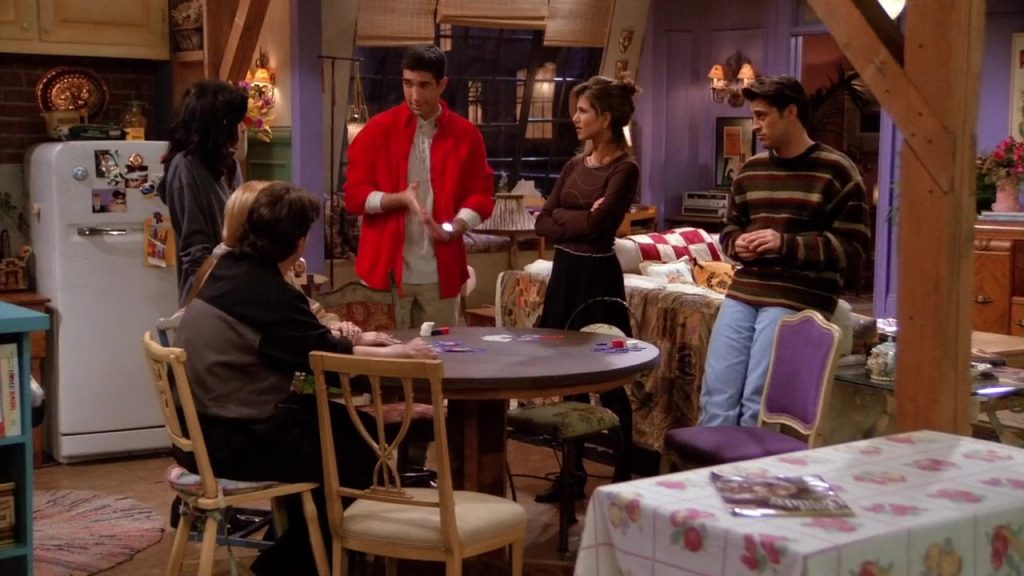
15. Gesturing
Original Movie Context
Monica: “I-I was gesturing, a-and the plate slipped out of my hand.”
Scene Description: Monica explains her actions during a poker game, indicating she was merely gesturing.
Word Breakdown
- Definition: Making movements of the hands or body to express an idea or meaning.
- Part of Speech: Verb (gerund)
- Pronunciation: /ˈdʒɛstʃərɪŋ/
- Etymology: From “gesture,” derived from Latin “gestus,” meaning “a gesture.”
Examples:
- He was gesturing towards the exit.
- She spent the meeting gesturing to emphasize her points.
Contextual Usage
- Formal: “The speaker was gesturing to engage the audience.”
- Informal: “He kept gesturing wildly while telling his story.”
- Collocations: Gesturing towards, gesturing with hands, gesturing expressively.
Learning Insights
- Pronunciation Tip: Break it down: JES-ture-ing.
- Common Mistake: Pronouncing “gesturing” as “jester-ing.”
- Memorization Trick: Visualize using your hands to remember “gesturing.”
Funfluen’s Word Pronunciation feature helps you practice saying “gesturing” correctly.
Conclusion
Learning English through your favorite movies like Friends S01 E18 makes language acquisition enjoyable and effective. By diving into authentic dialogues and scenes, you can expand your vocabulary and understand cultural nuances effortlessly. With Funfluen, your cinematic English study becomes even more powerful. Our language learning extension offers features like Mouse Dictionary, Save Words, and Fluency Gym to ensure you absorb new words seamlessly while watching. Embrace technology to transform your language learning journey today!
If you enjoyed learning from Friends S01E18, why not dive into previous episodes for even more fun and effective English practice? Each article introduces must-know vocabulary in a memorable, engaging way—making language learning as entertaining as binge-watching your favorite show!
- Master English with Friends S01E17: 12 Must-Know Vocabulary Words from Friends
Discover the words and expressions that made S01E17 a goldmine for language learners. - Mastering English Through Friends S01E16: Top Vocabulary Words to Boost Your Language Skills
Unlock practical vocabulary gems from the lively and relatable moments of Episode 16. - Mastering English Vocabulary with Friends S01 E15: Fun Lessons from Central Perk
Let the iconic coffee shop scenes from Episode 15 teach you English vocabulary in the most delightful way. - Mastering Cinematic English Study with Friends S01 E14: 15 Essential Vocabulary Words
Episode 14 is packed with expressions and cultural insights that make learning English via film a breeze. - Mastering English Vocabulary with “Friends S01 E13”: A Fun Learning Journey
Step back to Episode 13 for an unforgettable vocabulary-building journey filled with humor and heart.
Discover Funfluen’s Unique Features:
- Mouse Dictionary: Instantly define words by hovering over them.
- Save Words: Keep track of new vocabulary for future review.
- Fluency Gym: Engage with real-time movie dialogues to master speaking and listening.
- Download Subtitles: Access and study subtitles offline in various formats.
- Auto-Pause: Control playback for better comprehension.
Embark on an exciting adventure to learn English via film with Funfluen. Start today and watch your language skills soar!